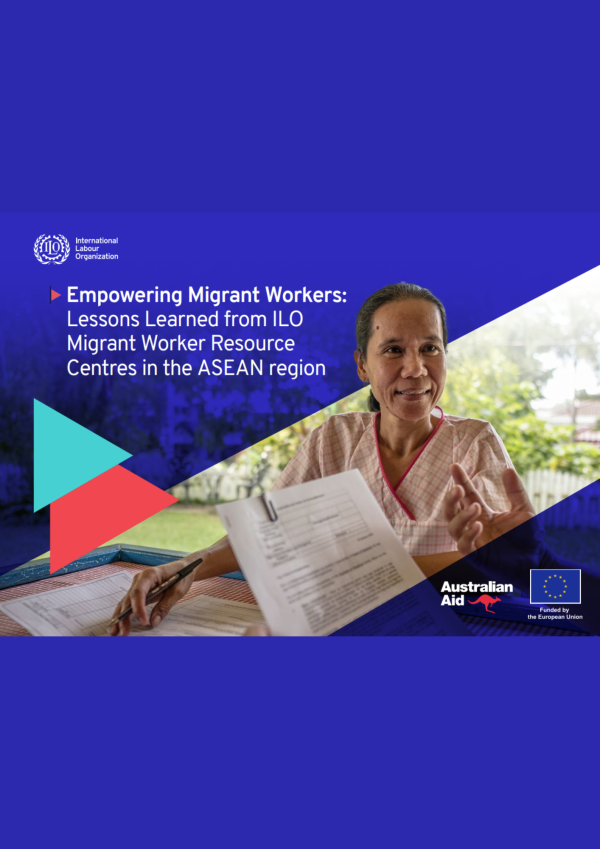
Empowering Migrant Workers: Lessons Learned from ILO Migrant Worker Resource Centres in the ASEAN region
This publication draws on the experience of the International Labour Organisation’s support for Migrant Worker Resource Centres (MRCs) in the ASEAN region. It highlights how these centres improve access to information, legal aid, and social protection for migrant workers while promoting safe migration, decent work, and long-term sustainability through strong community partnerships and rights-based approaches.
MRCs offer a wide range of services, including counselling, psychosocial support, legal aid, information, outreach, pre-migration and post-return training, and targeted programmes for migrant women, people with disabilities, fishers, seafood processors and domestic workers. Their role in organizing migrant workers into networks and trade unions has helped build a collective voice and empower migrant workers.
The publication offers practical guidance to governments, trade unions and civil society organizations on improving delivery of information and services to support safe migration for decent work. It advocates for further investments in community-based support structures that prioritize the labour rights and empowerment of migrant workers. It was commissioned by the ILO's TRIANGLE in ASEAN, Safe and Fair/ PROTECT and Ship to Shore Rights programmes.
Type of document :
Country/Region :
Year of publication :
Theme :
Promising practices for fair recruitment in Bangladesh: Digitised management of recruitment agencies
This document highlights promising practices for fair recruitment in Bangladesh with a focus on the use of digital technology for increased management of recruitment agencies and facilitating access to labour justice.
Type of document :
Country/Region : , ,
Year of publication :
Theme : , , , , , ,
Promising practices for fair recruitment in Nepal: Digitisation of labour migration processes for increased harmonization and oversight
This document highlights promising practices for fair recruitment in Nepal with a focus on the use of digital technology for increased harmonisation and oversight of migration processes.
Type of document :
Country/Region : , ,
Year of publication :
Theme : , , , , ,
10 Years of the Fair Recruitment Initiative: Milestones, Impact, and the Road Ahead
Discussion forum following the Fair Recruitment Initiative's 10-year anniversary webinar. Please feel free to continue the conversation here by posting questions and engaging with others./
Forum de discussion faisant suite au webinaire organisé à l'occasion du 10e anniversaire de l'initiative pour un recrutement équitable. N'hésitez pas à poursuivre la conversation en posant des questions et en échangeant des points de vue avec les autres participants./
Discussion forum following the Fair Recruitment Initiative's 10-year anniversary webinar. Please feel free to continue the conversation here by posting questions and engaging with others./
Forum de discussion faisant suite au webinaire organisé à l'occasion du 10e anniversaire de l'initiative pour un recrutement équitable. N'hésitez pas à poursuivre la conversation en posant des questions et en échangeant des points de vue avec les autres participants./
The use of digital technology in access to justice across borders
|27th September 2024 Time : 8:00am - 6:00pm
|Region/Country : ,
Theme : , , , ,
How service delivery for women migrant workers and their families in construction sector are strengthened in Thailand
Posted at February 16th 2023 12:00 AM | Updated as of February 16th 2023 12:00 AM
Region/Country : ,
|Themes : , , , ,
Rebels, victims, agents of change: The singular histories of women migrant workers
The purpose of this ethnographic study is to shed light on how women view their migration and work abroad. The findings challenge conventional narratives on labour migration of women and bring out important perspectives that invaluably inform policymaking.
The research provides in-depth qualitative data on women labour migration, free of a priori judgment in a context where such activity remains contested in many parts of society. The aim is to present on women’s migratory journeys and in the process re-visit these gender constructions, as well as the social class ranking that associates honour and rank with a specific gender order. It is an important reference for academics, activists and Government practitioners.
Type of document :
Country/Region : ,
Year of publication :
Theme : , , , ,
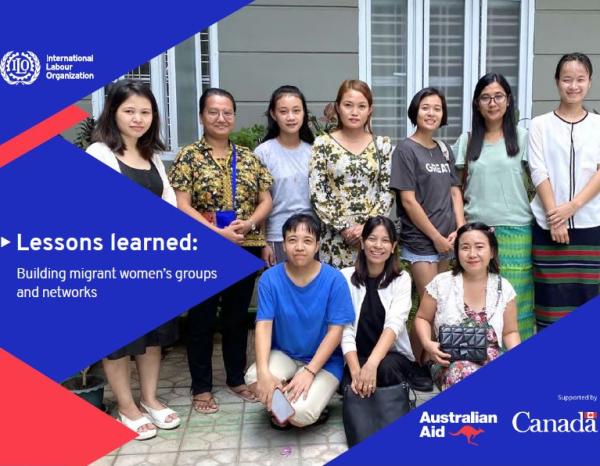
Lessons learned: Building migrant women’s groups and networks
The Lessons Learned outlined in this paper draw attention to reflections and good practices from the experiences of building of migrant women’s groups and networks in both countries of origin and destination.
The ILO’s TRIANGLE in ASEAN programme, supported by Global Affairs Canada and Australia’s Department of Foreign Affairs and Trade, recognizes that gender inequalities and discrimination limit the opportunities for women to benefit from migration, restrict women from reaching their full potential and increases the risk of exploitation. Aiming to increase women’s empowerment, TRIANGLE in ASEAN has supported six civil society organizations in Cambodia, Myanmar and Thailand to build migrant women’s groups and networks.
The ten lessons learned outlined in this paper cover practical issues including training of facilitators, the formation and maintenance of groups, and the building of wider networks nationally and cross-border. Other lessons learned address more complex issues that the migrant women’s groups have encountered. The lessons learned, like the groups themselves, are a work in progress. Building networks, tackling sensitive issues, advocating more broadly for the rights of migrant women and deepening the analysis of the complex social, economic and political factors through greater connectivity with social movements are all on the agenda for future interventions.
Women members of groups have gained more confidence, can more openly share and are expressing their opinions. Better informed, with more self-esteem, they are taking their own needs and knowledge into more consideration in decisions about migration. Migrant women’s group leaders are working together to advocate for policy changes and are prepared to tackle societal attitudes which discriminate against women and stigmatize migrant women.
The vibrant, enthusiastic migrant women’s groups built during this project are pleased to share their experiences with the hope that more migrant women will be able to build resilience through starting their own groups and be able to collectively address the inequalities, stigma and exploitation that migrant women currently face.
Type of document :
Country/Region : , , ,
Year of publication :
Theme : , ,
Organizing women migrant workers: Handout compendium
This handout compendium is meant to be used with the training manual "Organizing women migrant workers: Manual for trade unionists in ASEAN".
This handout compendium is a part of the training manual "Organizing women migrant workers: Manual for trade unionists in ASEAN". The handout compendium is meant to be used with the training manual. The training manual was produced jointly by the ILO Bureau for Workers’ Activities (ACTRAV) and the programme Safe and Fair: Realizing women migrant workers’ rights and opportunities in the ASEAN region. ACTRAV and Safe and Fair aim for this training manual and handout compendium to enable trade unions to address the specific needs of women migrant workers, bringing these two elements to
Type of document :
Country/Region :
Year of publication :
Theme : , , , ,
Organizing women migrant workers: Manual for trade unionists in ASEAN
This training manual was produced in collaboration between ILO Bureau for Workers’ Activities (ACTRAV) and Safe and Fair: Realizing women migrant workers’ rights and opportunities in the ASEAN region, a joint programme of the International Labour Organization and UN Women under the EU-UN Spotlight Initiative to eliminate violence against women and girls.
Trade unions regionally and globally often work on either migrants’ issues, or on gender equality and women’s empowerment. ACTRAV and Safe and Fair aim for this training manual to enable trade unions to address the specific needs of women migrant workers, bringing these two elements together.
This training manual was produced jointly by the ILO Bureau for Workers’ Activities (ACTRAV) and the programme Safe and Fair: Realizing women migrant workers’ rights and opportunities in the ASEAN region. Safe and Fair is jointly implemented by the ILO and UN Women, under the multi year European Union–United Nations Spotlight Initiative to end violence against women and girls.
Type of document :
Country/Region :
Year of publication :
Theme : , , , ,