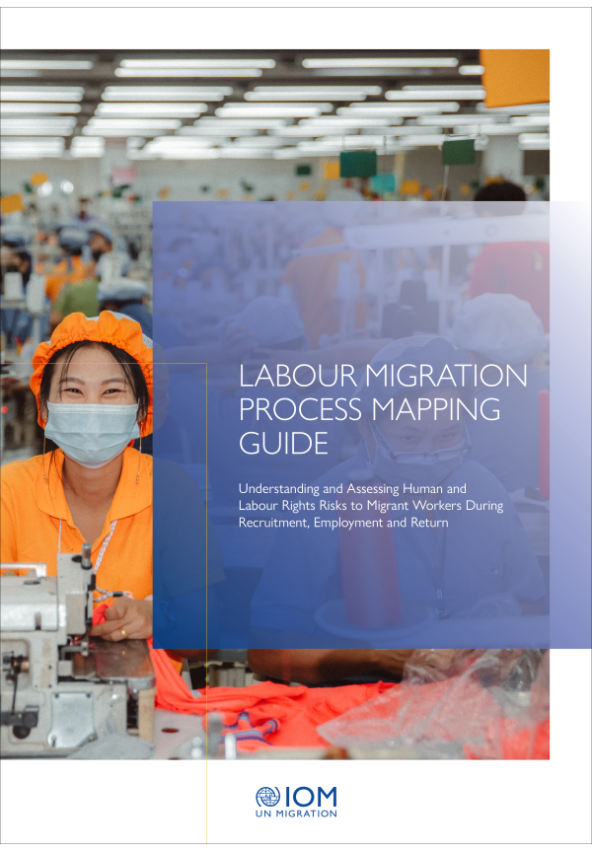
Labour Migration Process Mapping Guide: Understanding and Assessing Human and Labour Rights Risks to Migrant Workers During Recruitment, Employment and Return
The Labour Migration Process Mapping Guide aims to help business enterprises identify, mitigate, and address human and labour rights risks faced by migrant workers in global supply chains. It provides step-by-step instructions on how to retrace the steps that migrant workers take from their communities of origin to their workplaces in destinations, and determine the effectiveness of existing recruitment management systems to prevent and address forced labour risks.
Designed primarily for business enterprises with complex international supply chains where migrant workers are present, the Guide builds on the United Nations Guiding Principles on Business and Human Rights (UNGP) and relevant international human rights, labour standards and frameworks on responsible business conduct.
Notably, the Guide was a collaborative effort developed in consultation with governments, civil society, migrant workers and the private sector, as well as by the collection of good practices by employers, multinational enterprises and labour recruiters.
Three supporting tools, which include effective interview techniques and key considerations to ensure migrant worker safety and well-being, are also attached in the Guide. They are:
- Migrant Worker Interview Tool
- Employer Management Interview Tool
- Labour Recruiter Management Interview Tool
Type of document :
Country/Region :
Year of publication :
Theme : ,
Fair and Ethical Recruitment Due Diligence Toolkit by IOM
The International Organization for Migration (IOM) Fair and Ethical Recruitment Due Diligence Toolkit was developed to support business enterprises in fulfilling their responsibility to respect human rights in the context of international recruitment. It provides practical tools that enterprises can use to conduct comprehensive due diligence in line with the UN Guiding Principles on Business and Human Rights (UNGPs), the OECD Due Diligence Guidance for Responsible Business Practice, and IOM’s Migrant Worker Guidelines (MWGs). It can be used by enterprises to develop or strengthen due diligence processes in directly recruiting and managing business relationships with labour recruiters and private employment agencies that place migrant workers.
The tools within the Toolkit contain detailed guidelines and practical recommendations on how the due diligence processes described in the UNGPs and MWGs can be operationalized. The tools include interactive features that will direct users to the next due diligence process or the corresponding actions that are recommended for them to take. Enterprises may directly use or edit the tools to adapt to the unique nature of their operations and business relationships.
Tools to operationalize fair and ethical recruitment due diligence:
- 1. Embedding fair and ethical recruitment principles into policies and management systems
- 2. Identifying and assessing adverse human and labour rights impacts on migrant workers
- 3. Preventing and mitigating adverse human and labour rights impacts on migrant workers
- Corrective Action Plan Template (linked to the Self-assessment Checklist)
- Training Management Tool
- Pre-departure Orientation Checklist
- Post-arrival Orientation Template
- 4. Tracking implementation and results
- 5. Communicating how adverse impacts are addressed
- 6. Providing access to remedy
Access the full Toolkit here.
For questions, please email iom.dd.support@iom.int.
Type of document :
Country/Region :
Year of publication :
Theme : , , ,
Facilitating Journeys: The role of intermediaries in labour migration process from Nepal
What happens after the decision to migrate for work has been made? What steps do prospective migrants take, where do they obtain information and what services do they seek? This infographic is based on qualitative research amongst migrant workers that examines the wide range of intermediaries that workers encounter in their migration journey.
As part of its Integrated Programme on Fair recruitment (FAIR), a global programme supported by the Swiss Development Cooperation, the ILO in Nepal commissioned a study amongst prospective and returning migrant workers to document their experience and in particular their interaction with various intermediaries that are involved in the migration process. Qualitative data was collected through in-depth interviews with 32 men and 9 women migrant workers, originating from 5 provinces, that were either abroad or had recently returned to Nepal.
This infographic illustrates the collection of narratives from migrant workers and builds a picture of their experiences after deciding to migrate. Who do workers interact with as they prepare their journeys? Where do they gather information? How do they prepare for interviews and who supports the processing of job applications and contracts? How are visas obtained, and where do workers receive orientation and training? What costs do these various services amount to? Furthermore, what network of intermediation and support do workers connect with one they have reached their destination? And, finally, who do workers turn to settle outstanding issues upon return to Nepal?
Type of document :
Country/Region :
Year of publication :
Theme : , , , ,
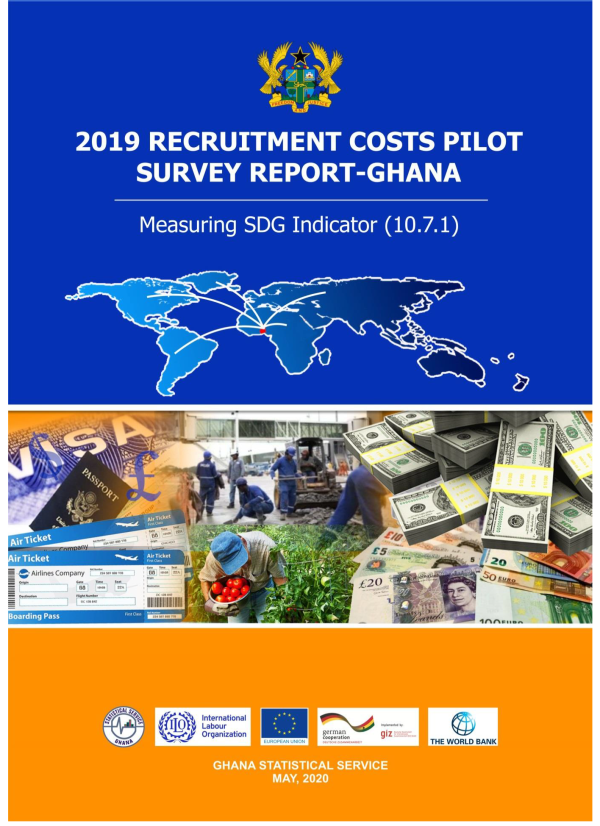
2019 Recruitment Costs Pilot Survey Report-Ghana, Measuring SDG Indicator (10.7.1)
This report presents the survey results and examines the recruitment costs, monthly earnings, and Recruitment Cost Indicator (RCI) of migrant workers taking into account their socio-demographic characteristics such as age, occupation, the industry of work, educational attainment, skills, and gender.
In 2019, the Ghana Statistical Service conducted the Recruitment Cost Pilot Survey (RCPS) in four administrative districts, namely, Mampong Municipal, Asante Akim North in the Ashanti Region, and Berekum and Techiman in the Bono and Bono East regions, respectively. The study was mainly designed to pilot an ILO recommended survey methodology to collect data on recruitment costs and monthly earnings of migrant workers from purposely selected districts, in a bid to calculate the SDG indicator 10.7.1 (Recruitment Cost Indicator). This report, therefore, presents the survey results, as it examines the recruitment costs, monthly earnings, and Recruitment Cost Indicator (RCI) of migrant workers taking into account their socio-demographic characteristics such as age, occupation, the industry of work, educational attainment, skills, and sex.
The results of this pilot study show that the survey methodology adopted for this study is suitable for estimating the RCI as required for measuring the SDG indicator 10.7.1. The study shows that the RCI levels, derived from average recruitment costs and monthly earnings for migrant workers, could plausibly be a function of skill level, country of destination, or educational level of the migrant worker. This is because lower levels of RCI could be associated with highly-skilled workers, highly educated migrant workers, and developed countries due largely to commensurate high monthly earnings, a result that resonates with our a-priori expectation.
The Ghana Statistical Service (GSS) implemented the study in collaboration with the International Labour Organization (ILO) with funding from the European Union.
Type of document :
Country/Region : ,
Year of publication :
Theme : , , , ,
The Impact of the New UK Immigration System on Human Trafficking into the UK
This paper explains how the immigration system opens up the potential for human trafficking and exploitation of individuals on a massive scale globally, orchestrated by organised crime gangs, criminals, scammers, profiteers and unscrupulous employers.
Type of document :
Country/Region :
Year of publication :
Theme : , , , , , , ,
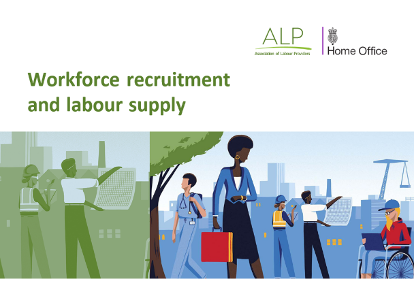
Workforce recruitment and labour supply
Produced by ALP in partnership with the UK Home Office, this guide provides specific, practical guidance for all UK recruiters, HR professionals and employers on actions that must and should be taken in respect of their existing workforce and future recruits in response to changes to the UK Immigration system.
Type of document :
Country/Region :
Year of publication :
Theme : , , , , ,
Making Fair Recruitment a Reality!
This video chronicles the ILO’s effort to establish a corridor to recruit fairly workers from Nepal to Jordan to work in the ready-made garment sector. It highlights the power of the various actors in a supply chain to make positive change when they work together to achieve a common objective that benefits each of them.
Type of document :
Country/Region :
Year of publication :
Theme : , ,

Agents of Change? Assessing Hong Kong employment agencies´ compliance with the Code of Practice
This report, based on a survey of over 450 migrant domestic workers, examines the implementation of the Hong Kong government’s Code of Practice for Employment Agencies (CoP), and its impact on the human and labour rights of domestic workers in the territory.
Type of document :
Country/Region :
Year of publication :
Theme : , , , ,