
From principles to practice: Fair recruitment at sectoral level
This global webinar will explore how fair recruitment principles can be translated into practice in agriculture, construction and hospitality, with practitioners sharing concrete recruitment models, operational challenges, solutions tested and lessons that could be applied across sectors and migrati...
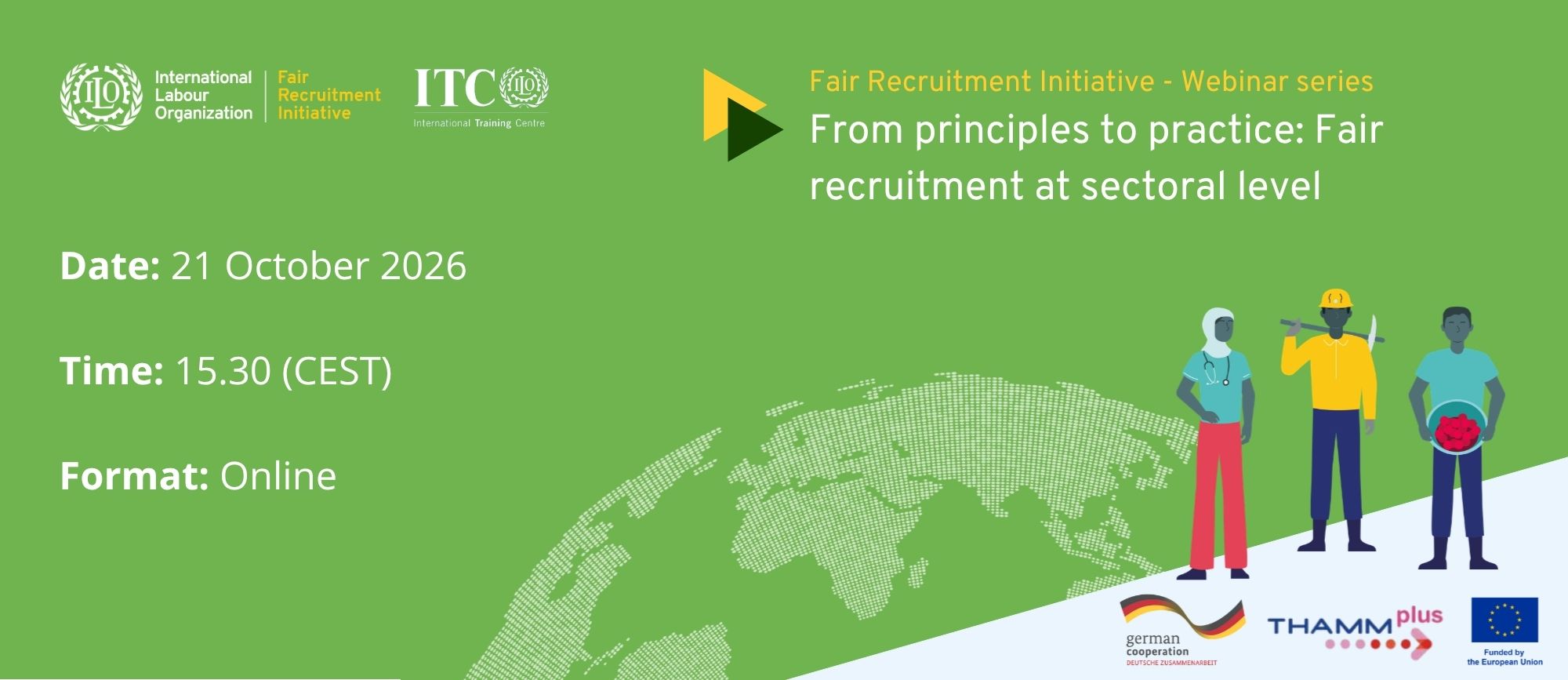
|21st October 2026 Time : 3:30pm - 5:30pm CET - Central European Time GMT+1:00
|Region/Country : Global
Theme : Fair recruitment
Background
Fair recruitment is fundamental to well-functioning labour markets and safe, regular and sustainable labour mobility. While the principles underpinning fair recruitment are universal, their implementation is highly sector-specific. Recruitment arrangements, labour shortages, required qualifications, the involvement of intermediaries, subcontracting structures and seasonality vary considerably between agriculture, construction and hospitality, as do the respective responsibilities of employers, labour recruiters, public employment services and public authorities.
International recruitment is increasingly used in these sectors to respond to labour and skills shortages. At the same time, migrant workers may face risks including recruitment fees and related costs, misleading information, abusive intermediaries, skills mismatch, complex subcontracting chains and insufficient access to complaint mechanisms and effective remedies. Addressing these risks requires practical solutions that reflect the realities of each sector and the recruitment models through which workers are placed.
The webinar will present practical experiences from different regions and examine how fair recruitment principles are being operationalized at the sectoral level. Through an interregional exchange, participants will hear from governments, employers’ and workers’ organizations, public and private employment services, labour recruiters and other practitioners about bilateral recruitment schemes, government-to-government arrangements, responsible private recruitment, sectoral due-diligence mechanisms and employer- or sector-led approaches.
The discussion will explore the respective roles and responsibilities of the actors involved and consider how recruitment fees and related costs, intermediary chains, skills recognition, worker information and access to effective remedies can be addressed in practice. Short sectoral case studies will be followed by reactions among speakers and a moderated discussion with participants, creating opportunities for peer learning and the identification of practices that could be adapted across sectors and migration corridors.
Please register here
The event is organised in collaboration with the ITCILO and supported by the Fair Recruitment Forward project, funded by the Deutsche Gesellschaft für Internationale Zusammenarbeit (GIZ), and the THAMM+ programme, funded by the European Union.