Employers and recruiters from Ghana and Nigeria explore digital tools for fair recruitment
Posted at November 17th 2026 12:00 AM | Updated as of November 17th 2026 12:00 AM
Region/Country : Ghana, Nigeria
|Themes : Fair recruitment, Labour migration
An ILO-supported exchange in Lagos examined how digital licensing systems can strengthen transparency and accountability in recruitment while protecting migrant workers’ rights.
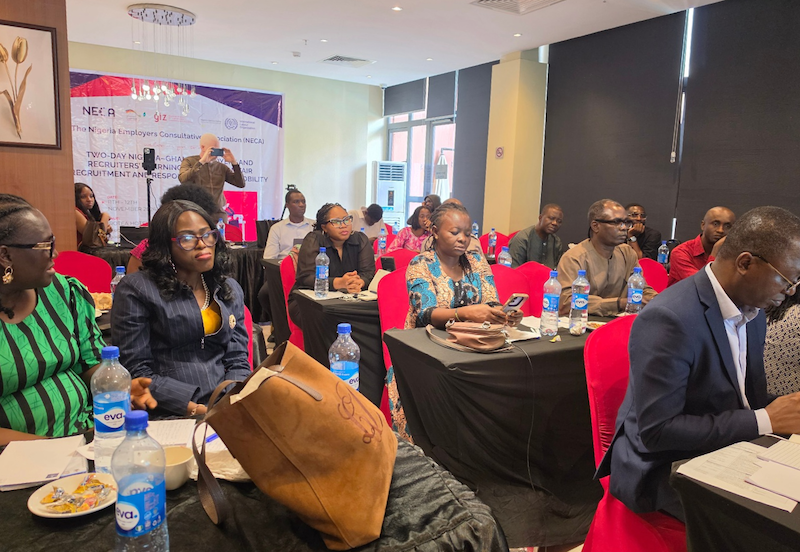
LAGOS, Nigeria (ILO News) – Employers and recruitment agencies from Ghana and Nigeria explored how digitalization can advance fair recruitment during a dedicated session on 12 November 2026. The hybrid discussion formed part of the workshop “From policy to practice: strengthening employers’ capacity to effectively engage on labour migration governance”, held in Lagos on 11–12 November.
Organized by the ILO Fair Recruitment Initiative and the International Training Centre of the ILO (ITCILO), in collaboration with the Nigeria Employers’ Consultative Association (NECA) and the ILO Country Office in Abuja, the session brought together experiences from Bangladesh, Nigeria and Ghana.
Participants learned about Bangladesh’s Recruiting Agents’ Information Management System and Nigeria’s preparations to test a contactless licensing system for private employment agencies through the National Electronic Labour Exchange (NELEX). Ghana shared its experience with manual registration procedures and ongoing discussions on digitalization.
The exchange highlighted opportunities to simplify licensing, improve regulatory oversight and help employers and workers verify whether recruitment agencies are licensed. It also emphasized that technology alone cannot resolve governance challenges: digital systems need effective safeguards, inclusive design and clear accountability.
Professor G. Harindranath of Royal Holloway, University of London introduced the AREAS framework Anticipate, Reflect, Engage, Act and Sustain, to guide responsible digitalization. Discussions addressed data protection, accessibility for smaller agencies, safeguards against arbitrary licensing decisions and the participation of workers’ organizations and other stakeholders.
The session underscored the importance of placing migrant workers’ rights at the centre of digital transformation. Its key messages informed subsequent work on an employer fair recruitment and responsible labour mobility checklist, linking peer learning to practical guidance for employers and recruiters.
This session was organised in collaboration with the ITCILO and supported by the Fair Recruitment Forward project, funded by the Deutsche Gesellschaft für Internationale Zusammenarbeit (GIZ).