
Technical report on fair recruitment of migrant workers with disabilities
The International Labour Organization (ILO) is committed to advancing fair recruitment practices that respect human rights and promote decent work for all. Since its launch in 2014, the ILO Fair Recruitment Initiative (FRI) has sought to ensure that recruitment processes are con-ducted in a fair, transparent, and inclusive manner, guided by international labour standards and rooted in the principles of equality and non-discrimination.
This technical report on fair recruitment of persons with disabilities, with a specific focus on migrant workers, represents an important step toward filling a critical knowledge gap at the intersection of disability inclusion, migration, and recruitment. While the ILO’s General Principles and Operational Guidelines for Fair Recruitment underscore the importance of non-discrimination, explicit guidance on the inclusion of persons with disabilities, particularly mi¬grant workers, remains limited.
By examining existing literature, identifying key challenges and good practices, and situating these within the framework of relevant ILO standards, this brief seeks to lay the groundwork for more inclusive recruitment policies and practices.
References
- DOI: https://doi.org/10.54394/BUNS0985
Type of document :
Country/Region :
Year of publication :
Theme : , ,

Fair recruitment Roadmap: A guide for national action
This roadmap is a practical step-by-step guide to assist national policymakers and recruitment stakeholders, including governments and social partners, in effectively implementing fair recruitment at the national level.
Type of document :
Country/Region :
Year of publication :
Theme : , , , , , ,

Winners of 2023 ILO Global Media Competition on Labour Migration announced
Posted at December 15th 2023 12:00 AM | Updated as of December 15th 2023 12:00 AM
Region/Country :
|Themes : , , , , , , , ,
Understanding patterns of structural discrimination of migrant and other workers in some countries of South and West Asia
This background paper reviews the literature that sheds light on the structural patterns of discrimination against migrant workers in some countries of South and West Asia. It also articulates recommendations that would help officials in UN agencies, international organizations, constituents and other civil society individuals and groups, while referring to the existing evidence of structural discrimination to support the application of international labour standards.
While references to international non-discrimination standards do occasionally surface in public discourses, this paper reviews evidence that discrimination in the world of work is not only characterized by socially deviant cases of discriminatory abuse, as reported in the media, but is rather intrinsic to the way various market economies and political systems are structured. This is manifested by indicators of privilege for some and indicators of deprivation for those at the bottom of the social and political hierarchies, including the interaction between both.
Type of document :
Country/Region : , , , , , , ,
Year of publication :
Theme : , , , , ,
ITUC Policy Brief: a new social contract for migrant workers
Decent Work deficits, xenophobia, racism and discrimination, conflicts, insufficient mitigation and adaptation to Climate Change mean many people have no choice but to accept substandard employment or undignified working conditions.
A New Social Contract is more urgent than ever to create more inclusive societies and economies, where migrants and their families can work and live with dignity. Workers call for a rights-based governance of migration that is designed, implemented and monitored through social dialogue and with international labour standards – such as freedom of association and collective bargaining rights – at the forefront.
Type of document :
Country/Region :
Year of publication :
Theme : , , , , , ,

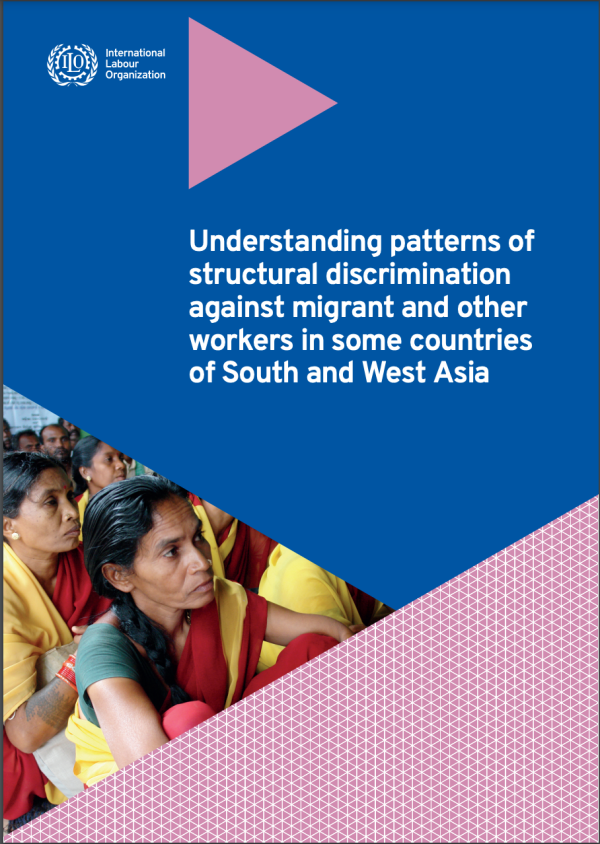
Understanding patterns of structural discrimination against migrant and other workers in some countries of South and West Asia
This background paper reviews the literature that sheds light on the structural patterns of discrimination against migrant workers in some countries of South and West Asia. It also articulates recommendations that would help officials in UN agencies, international organizations, constituents and other civil society individuals and groups, while referring to the existing evidence of structural discrimination to support the application of international labour standards.
While references to international non-discrimination standards do occasionally surface in public discourses, this paper reviews evidence that discrimination in the world of work is not only characterized by socially deviant cases of discriminatory abuse, as reported in the media, but is rather intrinsic to the way various market economies and political systems are structured. This is manifested by indicators of privilege for some and indicators of deprivation for those at the bottom of the social and political hierarchies, including the interaction between both.
Type of document :
Country/Region : , , , , , , ,
Year of publication :
Theme : , , , , ,
Establishing synergies and strategies to better protect women migrant workers
Posted at September 18th 2018 12:00 AM | Updated as of September 18th 2018 12:00 AM
Region/Country :
|Themes : , , , ,
Working in the UK
A short open source, animated video particularly for use by labour providers and employers to use in inductions for workers in the UK, explaining how to avoid problems, their rights at work, and where and how to report issues, in four sections covering: Before work during recruitment; Getting the correct pay; Staying safe and well at work; Key rights at work.
Type of document :
Country/Region :
Year of publication :
Theme : , , , , , ,