Working Paper on Operational Parameters to Assess Fair Recruitment Practices
These parameters list a series of questions and issues that should be looked into in order to assess recruitment practices.
In South Asia, the pathways to jobs in domestic, garment or other similar sectors within the region or to the Middle East are intersected by various agents or contractors in an environment shaped by multiple rules and practices determining the mobility of aspiring workers especially women. The fluidity and segmentation of labour supply chains and labour regimes are such that none of the key stakeholders such as labour recruiters, regulators and even employers can guarante on their own a fair migration outcome for any workers. To do so requires understanding the specificity of recruitment processes from end to end and strong multi-stakeholder cooperation. The purpose of these operational parameters is to identify the main fields that need to be assessed and related questions when analyzing recruitment processes.
Type of document :
Country/Region : , , , ,
Year of publication :
Theme : , , ,
Atelier de renforcement des capacités de membres du parlement ivoirien sur les conventions de l’OIT
Posted at July 14th 2023 12:00 AM | Updated as of July 14th 2023 12:00 AM
Region/Country :
|Themes : , , , , ,
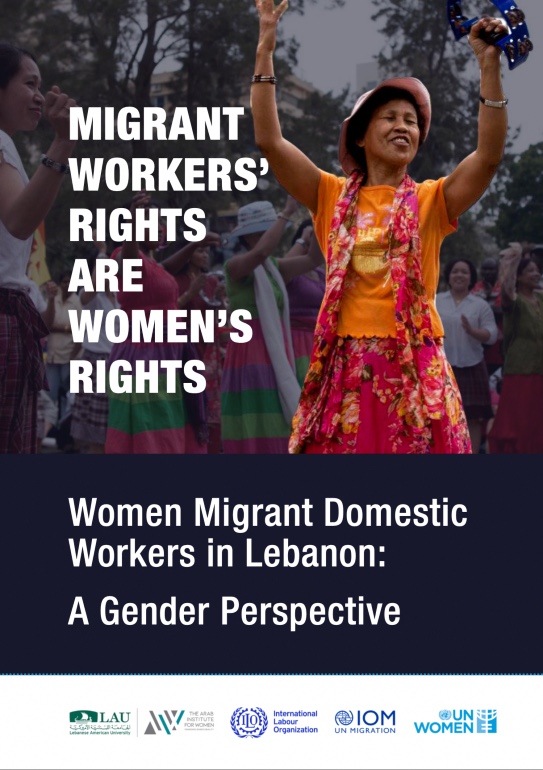
Women migrant domestic workers in Lebanon: A gender perspective
This paper illuminates the gender dimensions of women migrant domestic workers’ lived experiences in Lebanon under the kafala system. It examines the circumstances of women migrant domestic workers who live with their employer (live-in workers) and those who do not (live-out workers).
Type of document :
Country/Region :
Year of publication :
Theme : , ,
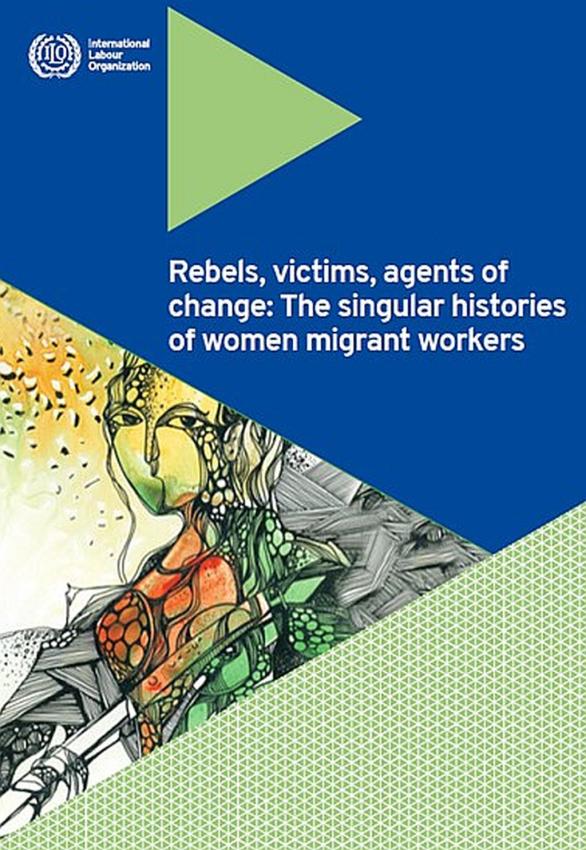
Rebels, victims, agents of change: The singular histories of women migrant workers
The purpose of this ethnographic study is to shed light on how women view their migration and work abroad. The findings challenge conventional narratives on labour migration of women and bring out important perspectives that invaluably inform policymaking.
The research provides in-depth qualitative data on women labour migration, free of a priori judgment in a context where such activity remains contested in many parts of society. The aim is to present on women’s migratory journeys and in the process re-visit these gender constructions, as well as the social class ranking that associates honour and rank with a specific gender order. It is an important reference for academics, activists and Government practitioners.
Type of document :
Country/Region : ,
Year of publication :
Theme : , , , ,
Regulating international labour recruitment in the domestic work sector: A review of key issues, challenges and opportunities
Based on a report written by Leanne Melnyk. It addresses the process of international recruitment of workers and highlights both the specific needs and vulnerabilities faced by migrant domestic workers, as well as the main issues and challenges, and innovative practices for better regulation of international recruitment in the domestic work sector.
Type of document :
Country/Region :
Year of publication :
Theme : , , , , ,
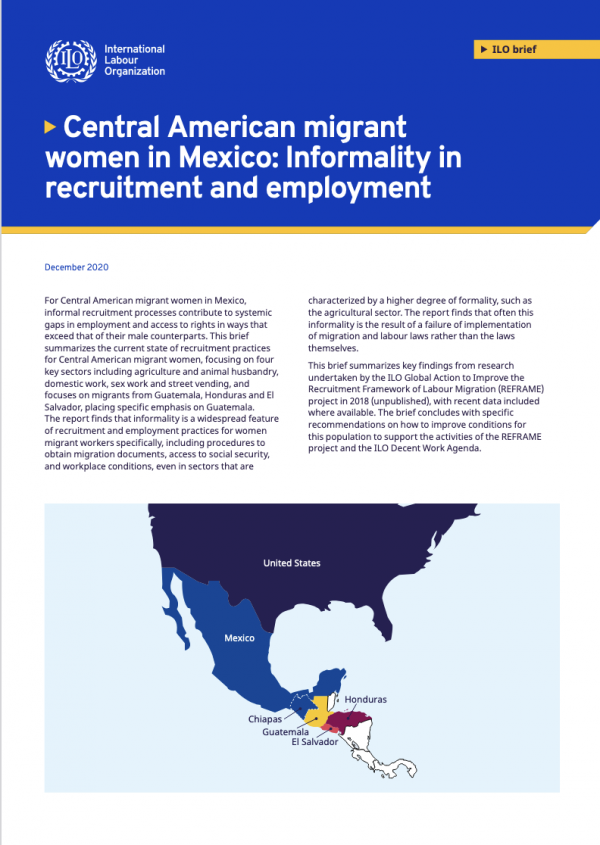
Central American migrant women in Mexico: Informality in recruitment and employment
This brief summarizes key findings from research undertaken by the ILO Global Action to Improve the Recruitment Framework of Labour Migration (REFRAME) project in 2018 (unpublished), with recent data included where available. The brief concludes with specific recommendations on how to improve conditions for this population to support the activities of the REFRAME project and the ILO Decent Work Agenda.
Type of document :
Country/Region :
Year of publication :
Theme :
Conceptualizing the role of intermediaries in formalizing domestic work
Domestic workers have long provided a range of services for families from cleaning and cooking to caring for children, the elderly and disabled, to driving household members and tending gardens. Despite the crucial services they provide, in many countries, domestic work is characterised by a high incidence of informal arrangements and contributes significantly to informality especially among women. The level of organization of the domestic work sector varies dramatically from country to country. In some countries, domestic workers are hired informally, by word of mouth, through social networks. In other countries, intermediaries – such as agencies, digital platforms, coops and others – play a role in recruiting, placing, and employing domestic workers. As the role of these intermediaries increases, questions arise about the impact intermediaries have on formalizing domestic work and providing decent work for domestic workers.
Type of document :
Country/Region :
Year of publication :
Theme : , , ,
Regional Planning Meeting for Promoting ASEAN Women Migrant Workers’ Rights through Organizing
|11th October 2018 Time : 8:30am - 4:45pm
|Region/Country : , , , , , , , , ,
Theme : , , , ,
Spotlight on Gender-sensitive Reporting in Journalism
|24th March 2021 Time : 2:30pm - 4:45pm
|Region/Country : , , , , , , , , , ,
Theme : , , ,
Gender sensitivity in labour migration agreements and MOUs
Global Action Programme on Migrant Domestic Workers - Research series in support of June 2016 project report release.
Type of document :
Country/Region :
Year of publication :
Theme : , , , , ,