
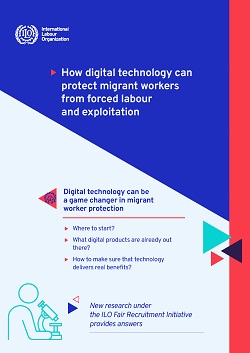
How digital technology can protect migrant workers from forced labour and exploitation
Digital technology can be a game changer in migrant worker protection. But where to start? What digital products are already out there? How to make sure that technology delivers real benefits? A new research under the ILO Fair Recruitment Initiative provides answers.
This infographic report features tips and advice on how to design, develop and promote digital products for migrant workers. It is based on the ILO research “Use of digital technology in the recruitment of migrant workers” (2021).
Type of document :
Country/Region :
Year of publication :
Theme : , , ,
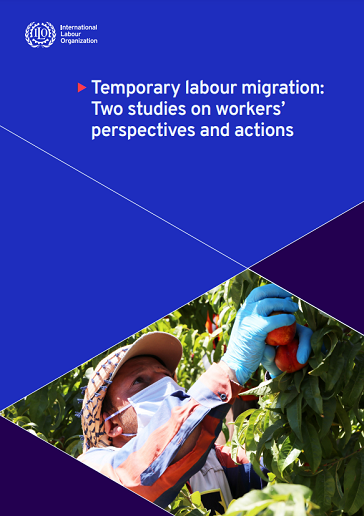
Temporary labour migration: Two studies on workers’ perspectives and actions
This report gathering two studies on workers organizations’ experience with temporary labour migration is part of a larger ILO project to gather knowledge on temporary labour migration.
The views on temporary labour migration vary greatly, including among ILO constituents. In light of the various concerns that the complex dynamics of temporary labour migration raise, it is crucial for the Office to capture constituents’ perspectives to enrich the debate. This document is an input from the Workers’ side to this process.
Type of document :
Country/Region :
Year of publication :
Theme : , , ,
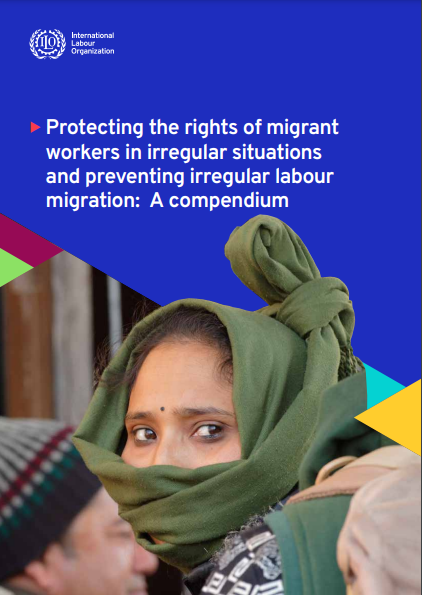
Protecting the Rights of Migrant Workers in an Irregular Situation and Preventing Irregular Labour Migration: A Compendium
The Compendium presents the situations that can lead migrant workers into irregularity, the rights of migrant workers in irregular situations, and the relevant international standards and good practice. It highlights laws, policies and practices that can help prevent irregular labour migration, and facilitate respect and promotion of the human rights of all migrant workers, regardless of status”. The Compendium is not intended to be exhaustive but is instead a living document that will be regularly updated with new examples and experiences. It seeks to encourage the sharing of good practices by states, social partners, and other actors concerned and to contribute to the attainment of the objectives of the Global Compact for Safe, Orderly and Regular migration.
Some of the references will be further updated in early 2022.
Type of document :
Country/Region :
Year of publication :
Theme : , , , ,
Migrant Worker Guidelines for Employers
This publication is to provide practical guidance for business enterprises on how to recruit and employ international migrant workers ethically and responsibly. The guidance offers concrete steps employers across various sectors can take to run their businesses in a manner that respects human and labour rights of migrant workers. The guidance is primarily for human resources and personnel engaged with migrant workers and can be integrated in existing company policies, procedures and practices.
The guidance builds on the United Nations Guiding Principles on Business and Human Rights (UNGP) and relevant international human rights and labour standards and frameworks on international migration. It has been developed as part of the IOM’s Corporate Responsibility in Eliminating Slavery and Trafficking (CREST) initiative, through an extensive multi-stakeholder consultation process.
The guidance is accompanied by a set of supporting tools including checklists, guidance notes and other useful documents, to help employers develop and implement the system, principles and practices to manage the labour migration process.
Supporting tools
- Summary - Common challenges and Risks Experienced by Migrant Workers at All Stages of Labour Migration
- Checklist - Labour Recruiter Service Agreements
- Guidance Note - Recruitment Fees and Related Costs
- Checklist - Employment Contracts
- Checklist - Migrant Workers' Accommodations
Type of document :
Country/Region :
Year of publication :
Theme : , , , , ,
Labour migration from Colombo Process countries Good practices, challenges and ways forward
Labour Migration from Colombo Process Countries: Good Practices, Challenges and Way Forward is the official background paper prepared by the International Organization for Migration (IOM) to inform the Fourth Colombo Process Ministerial Meeting held in Dhaka, Bangladesh in 2011. The report takes stock of current labour migration trends in the region, offers an analysis of good practices and identifies the challenges Colombo Process (CP) Member Countries face and their policy options in the immediate and long-term.
Since 2005, CP Member Countries have taken concrete, pro-active steps to manage labour migration through amending existing regulations or adopting new legislation, creating new government structures dedicated to managing labour outflow, and signing bilateral agreements (BAs) and memoranda of understanding (MOUs) with key destination countries. CP Member Countries have also launched innovative programmes and activities at different levels of government aimed at protecting labour migrants at home and abroad.
Despite success in key areas, however, difficult challenges remain, especially in implementation. There is often a gap between the aims of programmes as laid out on paper and how they are ultimately applied on the ground particularly on four key areas: disseminating of information, managing of the recruitment process, providing welfare support to migrants at both ends of the migration cycle and maximizing the benefits of labour migration. Success in any of these four areas requires serious investments in capacity building centered on a three-pronged strategy aimed at generating critical information, knowledge and policy-relevant research, formalizing practical dialogues and forging meaningful partnerships.
Type of document :
Country/Region :
Year of publication :
Theme : ,
IOM-MPI Issue in Brief No. 1 - Labour Migration from Colombo Process Countries: Good practices, challenges and ways forward
International migration has occurred throughout history and regions of the world. Human mobility to, from and within Asia, however, has certain distinctive features, and Asia represents arguably the most dynamic region, with significant intra- and extra-regional migration and some countries being simultaneously origins of and destinations for migrants.
The Migration Policy Institute (MPI) and the International Organization for Migration (IOM) Regional Office for Asia and the Pacific today launched an issue briefs series focusing in particular on labour migration in the region. The eight-part series also will examine diaspora engagement in Asia and climate-induced migration.
The first issue brief, Labour Migration from the Colombo Process Countries, examines labour migration from the 11 Colombo Process countries (Afghanistan, Bangladesh, China, India, Indonesia, Nepal, Pakistan, the Philippines, Sri Lanka, Thailand and Viet Nam). In 2010, an estimated 4.2 million workers migrated from these countries through official channels, many leaving on a temporary basis to work in the Middle East.
The Philippines sent the largest number (nearly 1.5 million), followed by India (641,000) and Indonesia (576,000). Overall, an estimated 44.7 million migrants from the region are living outside their country of origin.
Since 2005, the Colombo Process countries have taken concrete, proactive steps to manage the migration flows and protect their citizens working abroad, strengthening their legislative and administrative frameworks addressing recruitment regulation and welfare protection, as well as signing new accords with key destination countries. Despite the progress, however, the brief details a number of remaining challenges and highlights 10 possible areas of focus for governments.
“Governments in Colombo Process countries face a formidable task: creating efficient and equitable migration systems that benefit labour migrants and their families while contributing to long-term economic growth and development in countries of origin and destination,” said Andy Bruce, IOM regional director for Asia and the Pacific.
In June, IOM and MPI will publish the second issue brief, this one focusing on migrant health issues in the Asia-Pacific region. Subsequent briefs will be published every month through December, and will be available at IOM Online Bookstore and Migration Policy Institute.
Type of document :
Country/Region : , , , , , , , , , , ,
Year of publication :
Theme : , ,
Labour Migration in Asia: Protection of Migrant Workers, Support Services and Enhancing Development Benefits
This is the second volume of Labour Migration in Asia. The first volume (2003) looked at trends, challenges and policy responses in countries of origin. This volume describes and makes an assessment of specific initiatives in selected countries of origin to (1)protect migrant workers through the regulation of recruitment and setting of minimum standards in employment contracts, (2)provide support services to migrant workers through pre-departure orientation and a welfare fund and (3)enhance the development benefits of labour migration through training, skills development and remittances.
The articles are written by labour migration specialists and practitioners from the countries concerned and have been commissioned by IOM, the Department for International Development (UK) and the Asian Development Bank.
Type of document :
Country/Region :
Year of publication :
Theme : , ,
An Exploratory Study on Labour Recruitment and Migrant Worker Protection Mechanisms in West Africa: The Case of Côte d'Ivoire, the Gambia, Ghana, Nigeria and Senegal
The topics of ethical recruitment, defined as the recruitment of workers in a lawful, fair and transparent manner that respects their dignity and human rights, and labour migration, defined as the movement of persons from one State to another, or within their own country of residence, for the purpose of employment, go hand in hand. While labour migration can serve as a significant opportunity, it can also constitute a risk for those who partake in it. A risk may present itself if labour migration is undertaken as an end result of unethical recruitment practices, which may include practices that are non-transparent and fail to respect the dignity as well as human rights of workers. In such circumstances, workers may be at risk of exploitation during both the recruitment process and employment. Consistent adherence to ethical recruitment practices by all parties implicated in the recruitment process (including private recruitment agencies, employers and jobseekers) therefore significantly contributes to the reduction of these risks.
In West Africa, this correlation is particularly relevant as young West African migrants attracted by false promises of employment, high wages and decent working and living conditions are increasingly subjected to exploitative recruitment processes. Through this study, IOM seeks to shed light on this situation by assessing current recruitment practices and migrant worker protection mechanisms in place in the following case study countries: Côte d’Ivoire, the Gambia, Ghana, Nigeria and Senegal. This study explores and critically examines the existing evidence base on key aspects of the topic to inform potential policy and programmatic responses designed to enhance labour migration impacts for current and potential migrant workers located in as well as originating from West Africa. This publication entails both a desk-based review of the current published evidence base as well as insights derived from interviews with national stakeholders from the five case study countries.
This research publication was made possible through support provided by the Migration Resource Allocation Committee (MIRAC).
Type of document :
Country/Region : , , , , ,
Year of publication :
Theme : , , ,
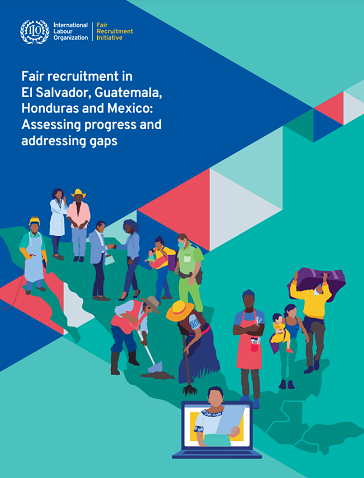
Fair recruitment in El Salvador, Guatemala, Honduras and Mexico: Assessing progress and addressing gaps
Analysis of progress and gaps in the regulatory framework, policies and enforcement on fair recruitment in the region and in each country, with recommendations to address regional and national challenges.
The document also compiles cases, good practices and recent efforts in various sectors and regions at local and international level by governments, employers' organisations and workers' organisations.
Type of document :
Country/Region : , , , ,
Year of publication :
Theme : , ,
El Salvador, Guatemala, Honduras and Mexico make progress in ensuring fair recruitment for migrant workers
Posted at May 15th 2023 12:00 AM | Updated as of May 15th 2023 12:00 AM
Region/Country : , , , ,
|Themes : , ,