
BRMM Countries Anchor Labour Migration Progress through the Fourth Labour Migration Advisory Group meeting in Juba
Posted at March 2nd 2026 12:00 AM | Updated as of March 2nd 2026 12:00 AM
Region/Country : South Sudan, Africa
|Themes : Labour migration, Labour migration governance
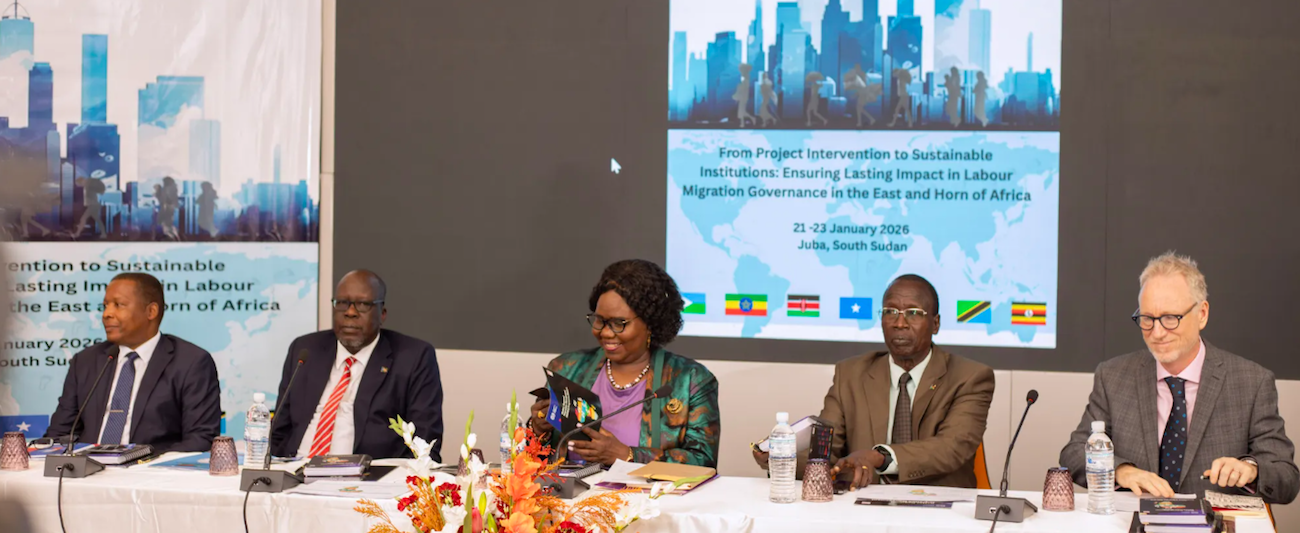
From 21 to 23 January 2026, senior officials from across the East and Horn of Africa convened in Juba, South Sudan, for the Fourth Labour Migration Advisory Group (LMAG) meeting under the Better Regional Migration Management (BRMM) Programme, funded by the UK Foreign, Commonwealth and Development Office (FCDO). Held in the final year of BRMM Phase II, the forum marked a pivotal transition from project-based interventions toward sustainable institutions, ensuring lasting impact on labour migration governance across the region.
Over 60 participants, including representatives from governments, social partners, national statistics offices, and private employment agencies from Djibouti, Ethiopia, Kenya, Somalia, South Sudan, Tanzania, and Uganda, convened for this high-level regional event. The meeting was also attended by key regional institutions such as the African Union Commission (AUC), the Intergovernmental Authority on Development (IGAD), the International Organisation of Employers (IOE), and ITUC-Africa.
Since the launch of the Labour Migration Advisory Group (LMAG) in 2023, each annual meeting has progressively strengthened the region’s labour migration governance framework. The inaugural session in Zanzibar introduced a three-tier governance model, laying the foundation for coordinated regional action. The 2024 meeting in Entebbe harmonised approaches to bilateral labour agreements and skills development. Building on this momentum, the 2025 session in Mombasa placed strong emphasis on embedding social dialogue within labour migration processes.
The fourth LMAG meeting, held in Juba, marked a significant milestone by consolidating these achievements and shifting the focus toward long-term ownership, institutional integration, and the development of a clear sustainability roadmap for labour migration governance in the region. Discussions over the three days centred on three core issues: building sustainable Labour Market Information Systems (LMIS) covering migration in the region; institutionalizing skills development, certification and recognition, while improving social protection coverage for migrant workers, to enhance their integration into the labour market; and the implementation of whole-of-government and whole-of-society approaches for enhanced social partners engagement, fair recruitment systems, regional cooperation and bilateral agreements. Presentations from BRMM countries highlighted progress on commitments made in the last LMAG, with a focus on key achievements, challenges and lessons learned to foster knowledge-sharing, strengthen regional collaboration and improve labour migration governance in the region.
The importance of fair recruitment practices and reintegration policies was a central theme of the discussion. Participants reviewed emerging national frameworks and structures, including the recently launched LMIS in Uganda, Somalia’s endorsed labour migration policy and private recruitment agencies regulation, Kenya’s proposed Migrant Workers Welfare Fund and Ethiopia’s skills development and recognition of prior learning strategies to improve employability locally and abroad. Sessions also underscored the critical role of Social partners, the importance of Migrant Resource Centres (MRCs), the need to standardize codes of conduct for Private Recruitment Agencies (PrEAs) in the region, and the relevance of scaling up the Migrant Recruitment Advisory (MRA).
In structured discussions during the group work and plenary sessions, country representatives mapped institutional pathways for embedding BRMM practices into national systems. At the end of the three days, consensus emerged around the need for clear mandates, stable financing, and cross-ministerial coordination for continuity. These exchanges also focused on aligning national efforts with AU-led frameworks such as the AU Migration Policy Framework for Africa (MPFA), the AU Free Movement Protocol, the Agenda 2063 commitments on mobility and employment, the Fair and ethical recruitment strategy and the African Union draft Labour Migration Model Law.
As attention turns to 2026–27, participating countries committed to a range of concrete follow-up actions, including finalising and endorsing regulatory frameworks, piloting skills recognition tools, facilitating portability of social protection benefits, strengthening the role of Migrant Resource Centres, aligning national frameworks with continental and regional policy instruments, and enhancing institutional capacity in data management, reintegration and labour market inclusion, and fair recruitment. There was a strong call for implementing common approaches as a region, sustained regional collaboration, deeper engagement with social partners and private recruitment agencies, and for embedding BRMM’s legacy within national development planning frameworks.
With BRMM entering its final year, the Juba LMAG meeting marked both a milestone and a mandate, calling on governments, social partners, and regional actors to assume full ownership of labour migration governance, institutionalise achieved gains, and safeguard the rights and aspirations of migrant workers across the East and Horn of Africa.