
South Sudan Trade Unions Mobilise for Migrant Worker Rights through National Capacity-Building Workshop
Posted at March 2nd 2026 12:00 AM | Updated as of March 2nd 2026 12:00 AM
Region/Country : South Sudan
|Themes : Migrant workers, Labour migration governance
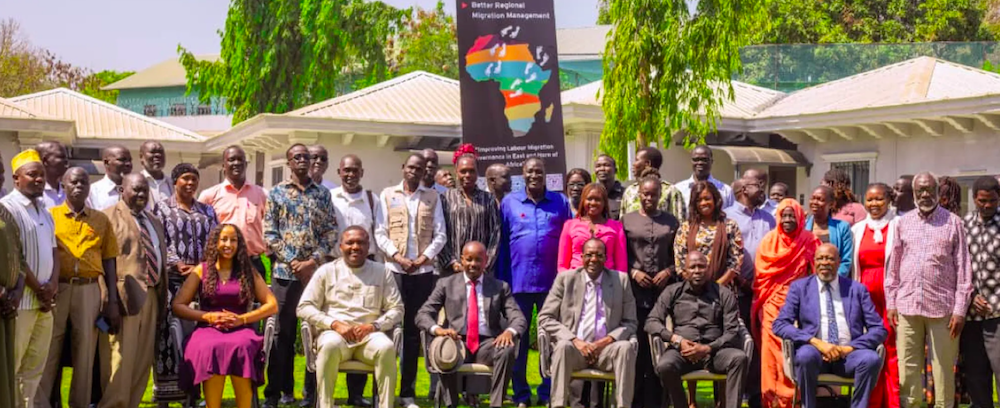
From 18 to 20 January 2026, 63 (15 female) participants representing trade unions, migrant worker communities, key ministries, employers, civil society, academia and international partners convened in Juba, South Sudan, for a three-day national workshop on organizing migrant workers and strengthening union leadership. Organised by the South Sudan Workers’ Trade Union Federation with support from the ILO Better Regional Migration Management Programme funded by the UK FCDO, the workshop focused on embedding migrant worker protection within national trade union structures.
The workshop builds on union-to-union agreements signed on 6 November 2023 between the SSWTUF and Confederation of Ethiopian Trade Unions (CETU) and SSWTUF and the National Organization of Trade Unions in Uganda (NOTU), based on the ITUC model agreement. These agreements aim to enhance labour migration governance and strengthen cross-border cooperation in protecting migrant workers’ rights.
The workshop followed a structured three-day agenda combining policy dialogue, technical presentations, and action planning. Day One featured opening remarks from SSWTUF leadership, the Employer Association of South Sudan, ITUC-Africa, the ILO, and the Ministry of Labour. The Ministry presented labour migration trends, noting data limitations and challenges in workplace registration and inspection. Migrant worker representatives and state union coordinators from multiple states provided contextual reports on migrant populations, sectors of employment and protection gaps.
Technical sessions included presentations on the ILO International Labour Standards and supervisory system, highlighting Conventions 97 and 143 on migrant workers, Convention 87 on freedom of association, and the importance of equality of treatment in wages, working conditions and trade union membership.
The workshop strengthened SSWTUF leadership capacity to engage in migration governance and protect migrant workers across sectors. Participants developed a draft roadmap and action plan to guide union-led organising efforts. Recommendations included increased collaboration with the ILO Workers’ Bureau, enhanced training programmes, improved outreach to migrant communities, and formal affiliation pathways linking migrant workers to union structures and resource centres. The discussions also reinforced the importance of tripartite cooperation, legal compliance, and alignment with international labour standards as central pillars of inclusive migration governance.
The workshop concluded with a reaffirmation of SSWTUF’s commitment to organising migrant workers and embedding migrant protection within national labour governance systems. With a clear roadmap in place and strengthened institutional capacity, trade unions are positioned to advance migrant workers’ inclusion through social dialogue, collective bargaining and sustained multi-stakeholder cooperation.