
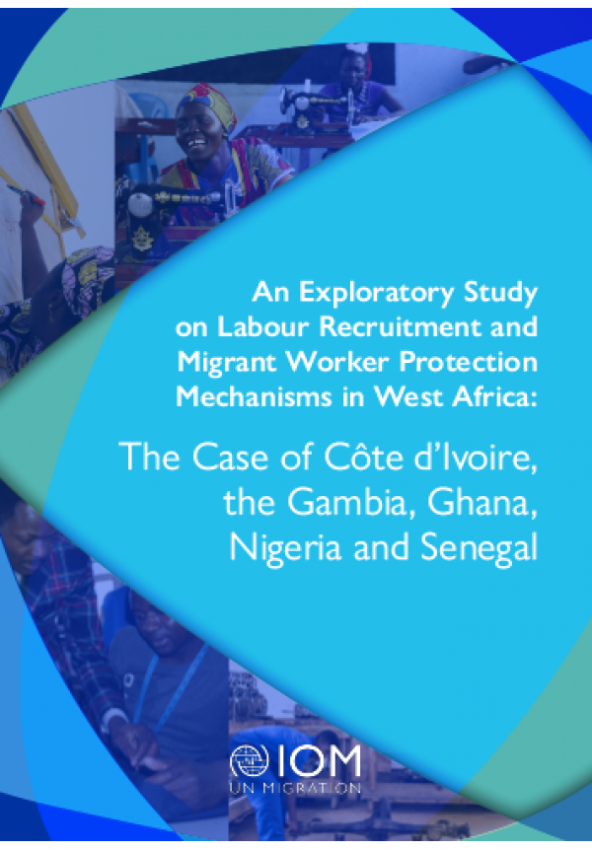
An Exploratory Study on Labour Recruitment and Migrant Worker Protection Mechanisms in West Africa: The Case of Côte d'Ivoire, the Gambia, Ghana, Nigeria and Senegal
The topics of ethical recruitment, defined as the recruitment of workers in a lawful, fair and transparent manner that respects their dignity and human rights, and labour migration, defined as the movement of persons from one State to another, or within their own country of residence, for the purpose of employment, go hand in hand. While labour migration can serve as a significant opportunity, it can also constitute a risk for those who partake in it. A risk may present itself if labour migration is undertaken as an end result of unethical recruitment practices, which may include practices that are non-transparent and fail to respect the dignity as well as human rights of workers. In such circumstances, workers may be at risk of exploitation during both the recruitment process and employment. Consistent adherence to ethical recruitment practices by all parties implicated in the recruitment process (including private recruitment agencies, employers and jobseekers) therefore significantly contributes to the reduction of these risks.
In West Africa, this correlation is particularly relevant as young West African migrants attracted by false promises of employment, high wages and decent working and living conditions are increasingly subjected to exploitative recruitment processes. Through this study, IOM seeks to shed light on this situation by assessing current recruitment practices and migrant worker protection mechanisms in place in the following case study countries: Côte d’Ivoire, the Gambia, Ghana, Nigeria and Senegal. This study explores and critically examines the existing evidence base on key aspects of the topic to inform potential policy and programmatic responses designed to enhance labour migration impacts for current and potential migrant workers located in as well as originating from West Africa. This publication entails both a desk-based review of the current published evidence base as well as insights derived from interviews with national stakeholders from the five case study countries.
This research publication was made possible through support provided by the Migration Resource Allocation Committee (MIRAC).
Type of document :
Country/Region : , , , , ,
Year of publication :
Theme : , , ,
Interregional meeting: Strengthening cooperation of trade unions from Africa and from Arab States to advance Fair Recruitment, Freedom of Association and Just Transition for Migrant Workers
|3rd July 2023 Time : 12:00am - 12:00am
|Region/Country : , ,
Theme : ,
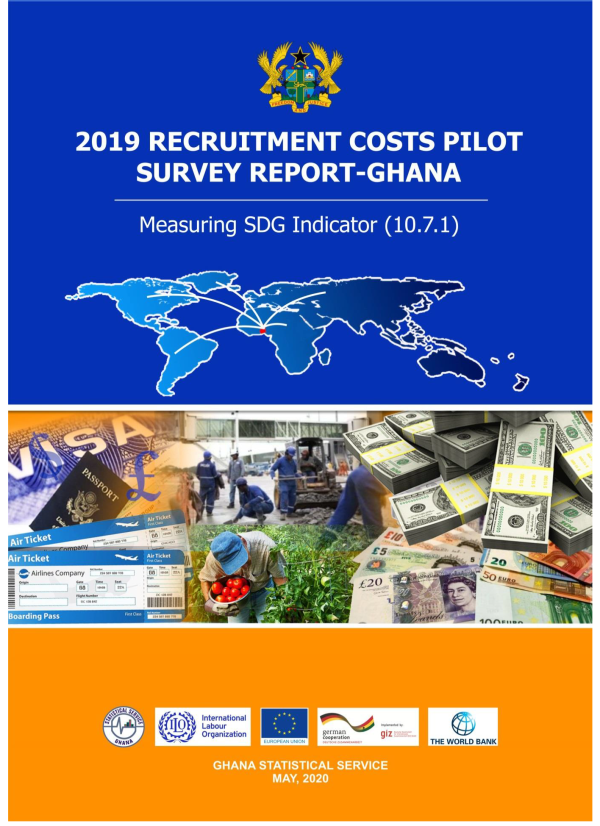
2019 Recruitment Costs Pilot Survey Report-Ghana, Measuring SDG Indicator (10.7.1)
This report presents the survey results and examines the recruitment costs, monthly earnings, and Recruitment Cost Indicator (RCI) of migrant workers taking into account their socio-demographic characteristics such as age, occupation, the industry of work, educational attainment, skills, and gender.
In 2019, the Ghana Statistical Service conducted the Recruitment Cost Pilot Survey (RCPS) in four administrative districts, namely, Mampong Municipal, Asante Akim North in the Ashanti Region, and Berekum and Techiman in the Bono and Bono East regions, respectively. The study was mainly designed to pilot an ILO recommended survey methodology to collect data on recruitment costs and monthly earnings of migrant workers from purposely selected districts, in a bid to calculate the SDG indicator 10.7.1 (Recruitment Cost Indicator). This report, therefore, presents the survey results, as it examines the recruitment costs, monthly earnings, and Recruitment Cost Indicator (RCI) of migrant workers taking into account their socio-demographic characteristics such as age, occupation, the industry of work, educational attainment, skills, and sex.
The results of this pilot study show that the survey methodology adopted for this study is suitable for estimating the RCI as required for measuring the SDG indicator 10.7.1. The study shows that the RCI levels, derived from average recruitment costs and monthly earnings for migrant workers, could plausibly be a function of skill level, country of destination, or educational level of the migrant worker. This is because lower levels of RCI could be associated with highly-skilled workers, highly educated migrant workers, and developed countries due largely to commensurate high monthly earnings, a result that resonates with our a-priori expectation.
The Ghana Statistical Service (GSS) implemented the study in collaboration with the International Labour Organization (ILO) with funding from the European Union.
Type of document :
Country/Region : ,
Year of publication :
Theme : , , , ,
Journalists have a key role to play in the collective effort to eliminate child labour
Posted at June 4th 2021 12:00 AM | Updated as of June 4th 2021 12:00 AM
Region/Country :
|Themes : ,
The ILO launches the Fair recruitment Initiative (Phase II, 2021-2025) for Africa Region
|24th March 2022 Time : 9:00am - 6:00pm
|Region/Country :
Theme :
Business and private sector engagement
Region/Country : , , , , , ,
|Themes :
About
Objectives
Relevant thematic content
Forum Topic
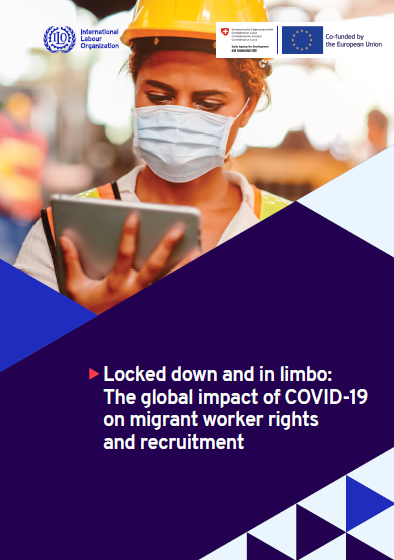
Locked down and in limbo: The global impact of COVID-19 on migrant worker rights and recruitment
The COVID-19 pandemic has had a devastating impact on migrant workers and their access to decent work. Beyond the immediate public health crisis, response measures including lockdowns and border closures had specific implications for the hiring and employment conditions of migrant workers. These measures have increased the vulnerability of migrant workers at the same time as the economic and social dependence on migrant workers who deliver essential services such as healthcare and sanitation has deepened.
To chart and understand this impact in detail, the ILO commissioned a series of rapid assessments in some of the world’s most significant corridors for low-wage migrant workers. Completed in the initial months of the crisis (early to mid-2020), these assessments gathered primary data in the form of interviews and surveys from the perspective of migrant workers and key stakeholders (including governments, civil society, the recruitment sector, employers’ organizations, unions and workers’ organizations) engaged in migration governance, migrant worker deployment and the protection of the rights of migrant workers.
These rapid assessments provide valuable snapshots of the immediate impact of the pandemic and early responses to the pandemic on migrant workers in various parts of the world. Common themes emerging from the research also illustrate the ways in which the pandemic exacerbated existing inequalities and vulnerabilities experienced by migrant workers globally. These themes demonstrate the clear linkages between the impact of the pandemic on migrant workers and the structural causes of the inequalities and vulnerabilities embedded in many current labour migration processes and practices.
Drawing on the rapid assessments, this report provides a global picture of the impact of the crisis on migrant workers, and provides valuable recommendations for ensuring protection of migrant workers’ rights.
Type of document :
Country/Region : , , , ,
Year of publication :
Theme : , , , ,
Promoting fair and ethical recruitment in a digital world
Digital technology platforms are proliferating, particularly as more countries move processes online in response to the COVID-19 pandemic. These platforms, if well-designed and implemented, have the potential to play a key role in supporting fair and ethical recruitment, particularly in promoting institutional transparency, efficiency, reduced cost of recruitment, and government oversight.
Digital technology platforms are proliferating, particularly as more countries move processes online in response to the COVID-19 pandemic. These platforms, if well-designed and implemented, have the potential to play a key role in supporting fair and ethical recruitment, particularly in promoting institutional transparency, efficiency, reduced cost of recruitment, and government oversight.
Awareness-raising workshop for domestic workers led by the National Union of Malagasy Domestic Workers (SENAMAMA)
|29th November 2020 Time : 2:00pm - 5:00pm
|Region/Country : ,
Theme : , ,
How can individuals act to eliminate child labour in their communities?
Posted at June 4th 2021 12:00 AM | Updated as of June 4th 2021 12:00 AM
Region/Country :
|Themes :