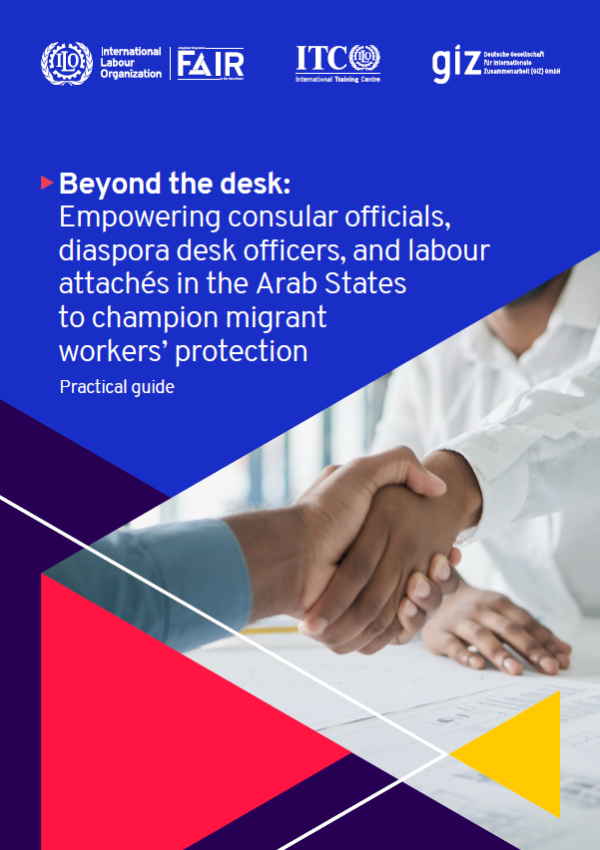
Empowering consular officials, diaspora desk officers, and labour attachés in the Arab States to champion migrant workers’ protection
Beyond the Desk: Empowering Consular Officials, Diaspora Desk Officers, and Labour Attachés in the Arab States to Champion Migrant Workers’ Protection is a practical guide developed within the framework of the Ghana component of the International Labour Organization (ILO) Integrated Programme on Fair Recruitment (FAIR II). FAIR, a global programme established in 2015 to support the implementation of the ILO Fair Recruitment Initiative Strategy, promotes fair recruitment practices in selected countries of origin and destination and across key labour migration corridors.
In its current phase, implemented with the support of GIZ, FAIR II seeks to strengthen stakeholder ownership and facilitate the replication and scaling up of promising practices in migration corridors where partners are committed to improving recruitment systems and outcomes. This guide has been developed specifically to support Ghanaian consular officials, labour attachés, and diaspora desk officers posted in the Arab States in protecting the rights of migrant workers in contexts shaped by Kafala and other sponsorship-based systems, while promoting respect for the Fundamental Principles and Rights at Work (FPRWs).
While grounded in the experiences and institutional context of the Ghana–Arab States labour migration corridor, the approaches, tools, and guidance presented in this publication address challenges common to many countries of origin in the region. As such, the guide is intended not only as a resource for Ghana but also as a reference that can be adapted, expanded, and applied by other countries seeking to strengthen the capacity of their diplomatic and consular missions to support and protect migrant workers abroad. The work undertaken under the Ghana corridor reflects the four pillars of the ILO Fair Recruitment Initiative Strategy by strengthening knowledge and policy guidance on recruitment processes, supporting improvements in laws, policies and enforcement mechanisms, promoting fair business practices, and enhancing migrant workers’ access to reliable information and services throughout the recruitment process.
Designed for use in day-to-day mission practice, briefings, training programmes, and coordinated case management with partners in countries of origin and destination, this guide aims to support informed and practical decision-making while reinforcing a consistent and rights-based approach to migrant worker protection. It is hoped that the experiences and lessons generated through its use will contribute to stronger institutional cooperation, enhanced capacity-building efforts, and continuous improvements to recruitment and employment systems across the region, ultimately making labour migration safer, fairer, and more firmly grounded in dignity and human rights.
You can also access the online version of the guide.
Type of document :
Country/Region : , ,
Year of publication :
Theme : ,
ILO and Jordanian trade unions strengthen their partnership to advance migrant workers' rights
Posted at July 6th 2026 12:00 AM | Updated as of July 6th 2026 12:00 AM
Region/Country : ,
|Themes : ,
Establishing Fair Recruitment Processes
|22nd September 2025 Time : 9:00am - 5:00pm
|Region/Country : ,
Theme :
10 Years of the Fair Recruitment Initiative: Milestones, Impact, and the Road Ahead
Discussion forum following the Fair Recruitment Initiative's 10-year anniversary webinar. Please feel free to continue the conversation here by posting questions and engaging with others./
Forum de discussion faisant suite au webinaire organisé à l'occasion du 10e anniversaire de l'initiative pour un recrutement équitable. N'hésitez pas à poursuivre la conversation en posant des questions et en échangeant des points de vue avec les autres participants./
Discussion forum following the Fair Recruitment Initiative's 10-year anniversary webinar. Please feel free to continue the conversation here by posting questions and engaging with others./
Forum de discussion faisant suite au webinaire organisé à l'occasion du 10e anniversaire de l'initiative pour un recrutement équitable. N'hésitez pas à poursuivre la conversation en posant des questions et en échangeant des points de vue avec les autres participants./
Inaugural FAIR III Project Advisory Board Meeting Sets Course for Fair Recruitment in Ghana
Posted at December 7th 2023 12:00 AM | Updated as of December 7th 2023 12:00 AM
Region/Country : , , ,
|Themes : , ,
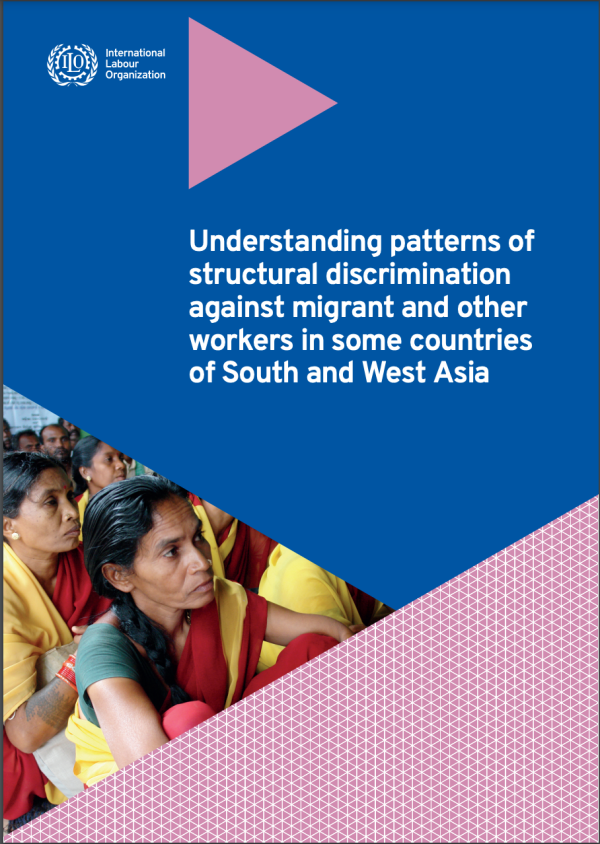
Understanding patterns of structural discrimination of migrant and other workers in some countries of South and West Asia
This background paper reviews the literature that sheds light on the structural patterns of discrimination against migrant workers in some countries of South and West Asia. It also articulates recommendations that would help officials in UN agencies, international organizations, constituents and other civil society individuals and groups, while referring to the existing evidence of structural discrimination to support the application of international labour standards.
While references to international non-discrimination standards do occasionally surface in public discourses, this paper reviews evidence that discrimination in the world of work is not only characterized by socially deviant cases of discriminatory abuse, as reported in the media, but is rather intrinsic to the way various market economies and political systems are structured. This is manifested by indicators of privilege for some and indicators of deprivation for those at the bottom of the social and political hierarchies, including the interaction between both.
Type of document :
Country/Region : , , , , , , ,
Year of publication :
Theme : , , , , ,
IOM-MPI Issue in Brief No. 4 - Regulating Private Recruitment in the Asia-Middle East Labour Migration Corridor
The Middle East represents one of the most sought-after and competitive labour markets in the world, with an estimated 10 million contract workers in the Gulf states alone – 70 per cent of whom are Asian.
The vast majority of this temporary labour movement is brokered by recruitment agencies; and with the supply of labour overwhelmingly outweighing demand, oversight of recruitment practices is extremely difficult. Migrant workers are willing to pay a stiff premium to work in the Middle East, even in the face of onerous placement fees and less-than-ideal work and living conditions once at destination.
In Regulating Private Recruitment in the Asia? Middle East Labour Migration Corridor, author Dovelyn Rannveig Agunias examines how sometimes unscrupulous recruitment agencies take advantage of the migrants they purport to serve, by charging excessive placement fees and offering expensive pre-departure loans.
The issue brief, the fourth in a series launched by the Migration Policy Institute (MPI) and the International Organization for Migration’s Regional Office for Asia and the Pacific, discusses the policy options that could be implemented to curb abuses by increasing government intervention in recruitment operations.
Available policy levers for regulating recruitment practices are many and should aim to achieve the following overarching goals: (1) reduce the number of recruitment agencies to an optimal level to prevent cut-throat competition, (2) bring subagents and brokers into the formal sector, (3) regulate transactions among recruiters and between recruiters and employers and (4) harmonize regulations governing recruitment agencies at origin and destination.
The issue brief suggests that governments at both origin and destination should become involved by introducing parallel measures (such as provision of equal treatment and basic rights) that empower labour migrants and give them the needed negotiating leverage in an otherwise unequal employment relationship.
The IOM-MPI issue briefs, a monthly joint-publication offering succinct insights on migration issues affecting the Asia-Pacific region today, are available at IOM Online Bookstore and Migration Policy Institute.
Type of document :
Country/Region : ,
Year of publication :
Theme : , ,
Interregional meeting: Strengthening cooperation of trade unions from Africa and from Arab States to advance Fair Recruitment, Freedom of Association and Just Transition for Migrant Workers
|3rd July 2023 Time : 12:00am - 12:00am
|Region/Country : , ,
Theme : ,
Understanding patterns of structural discrimination against migrant and other workers in some countries of South and West Asia
This background paper reviews the literature that sheds light on the structural patterns of discrimination against migrant workers in some countries of South and West Asia. It also articulates recommendations that would help officials in UN agencies, international organizations, constituents and other civil society individuals and groups, while referring to the existing evidence of structural discrimination to support the application of international labour standards.
While references to international non-discrimination standards do occasionally surface in public discourses, this paper reviews evidence that discrimination in the world of work is not only characterized by socially deviant cases of discriminatory abuse, as reported in the media, but is rather intrinsic to the way various market economies and political systems are structured. This is manifested by indicators of privilege for some and indicators of deprivation for those at the bottom of the social and political hierarchies, including the interaction between both.
Type of document :
Country/Region : , , , , , , ,
Year of publication :
Theme : , , , , ,
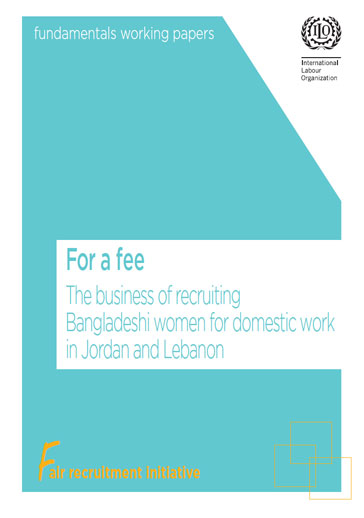
For a fee: The business of recruiting Bangladeshi women for domestic work in Jordan and Lebanon
This working paper aims to shed light on the business models of labour recruiters that facilitate the recruitment of women from South Asian countries into domestic work in the Middle East, with a particular focus on Bangladesh, Jordan and Lebanon.
Focusing primarily on Bangladesh, Jordan and Lebanon, the study draws on 126 interviews conducted with key stakeholders, to analyse the recruitment ‘business model’ utilised by private employment agencies specialising on the domestic work sector.
Globally, the international recruitment industry is composed of an increasingly complex web of actors. In order to profit, private employment agencies must devise competitive strategies to generate income greater than the costs of selecting, processing and mobilising people into jobs. Such business models are dynamic and responsive to changes in market demands and skills’ availability.
The study also assesses the influence of national laws, policies and regulations on how private employment agencies conduct their business. By illuminating the factors that guide the actions of private employment agencies, the study aims to inform better policies and interventions to protect migrant domestic workers and eliminate abusive practices.
Type of document :
Country/Region : , , , ,
Year of publication :
Theme : ,