ALP Response to IASC ‘Operation Fort – Addressing the Underlying Causes’
ALP’s response to the UK Independent Anti-Slavery Commissioner’s recommendations to support ethical businesses to embed human rights due diligence into the DNA of their organisation and supply chain – so that worker exploitation is minimised wherever possible and remediated where identified.
Type of document :
Country/Region :
Year of publication :
Theme : , , ,
Addressing Food Industry Labour Shortages
Labour supply in the UK has been tightening for a number of years. A challenging environment is now tipping into crisis with both labour providers and employers agreeing that the food industry will not have access to the labour it needs this year or in the foreseeable future. This paper examines the causes and suggests actions to address.
Type of document :
Country/Region :
Year of publication :
Theme : , , ,

CIERTO Mexico - Fair recruitment practice adapted to COVID-19
CIERTO’s recruitment policy is aligned to ILO’s General Principles and Operational Guidelines for Fair Recruitment (GPOG) and puts emphasis on: a) promotion of employer paid recruitment; b) a shared responsibility approach in the labour supply chain to ensure adequate protection of migrant workers; c) Strengthening communities of origin’s knowledge on fair recruitment by developing third-party independent, human rights based monitoring of recruitment within communities of origin. They also train workers on how complaint mechanisms work with their employer, assist them in filing a complaint if necessary, and intervene only when a complaint does not receive a timely resolution. A third-party independent monitoring actor supervises CIERTO’s work in communities of origin (mostly so that no recruitment fees are charged). They also visit employers at destination to ensure that CIERTO’s description of workplace conditions is accurate, and they conduct worker’s surveys upon return to document any potential abuse either by the recruiter (CIERTO) or by the employer.
Type of document :
Country/Region : , ,
Year of publication :
Theme :

Asegurar la contratación equitativa durante la pandemia de la COVID-19
En el presente informe se destacan los principales desafíos de la contratación nacional e internacional de trabajadores durante la pandemia de la COVID-19, la respuesta de la OIT así como las políticas y medidas recomendadas. En el anexo se describen las prácticas de las partes interesadas para promover la contratación equitativa durante la pandemia de la COVID-19.
Type of document :
Country/Region :
Year of publication :
Theme : , ,
Modulo sobre costos de contratación en la EMIF Sur y prueba del indicador 10.7.1 de los ODS. Reporte de resultados
En 2019, la OIT y el COLEF colaboraron para medir los costos de contratación en los que incurrían los migrantes centroamericanos en México. Se añadió dicho módulo a la encuesta anual del COLEF (EMIF Sur). El módulo se basó en la metodología empleada por OIT-Banco Mundial para medir el Indicador de Costos de Contratación (RCI) del Objetivo de Desarrollo Sostenible 10.7.1. En este reporte se muestran los resultados de dicho ejercicio y se elaboran recomendaciones para su futura realización en otros corredores migratorios.
Type of document :
Country/Region : ,
Year of publication :
Theme : , ,
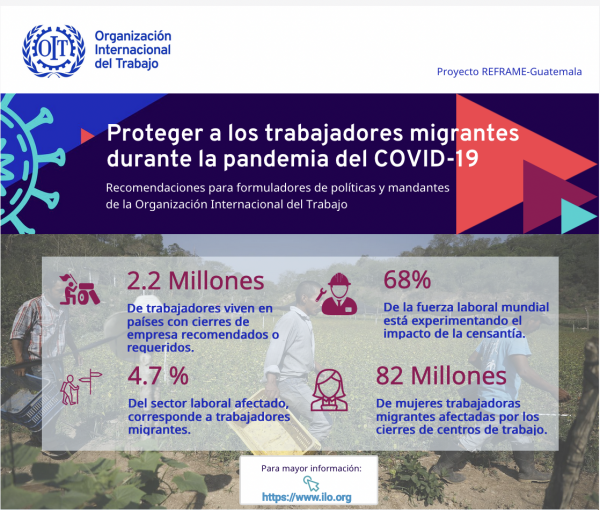
Protecting migrant workers during the COVID-19 pandemic
The infographic seeks to inform on the need to protect migrant workers during the COVID-19 pandemic by providing recommendations for policy makers and ILO constituents.
It provides facts and figures on Guatemalans abroad, return of Guatemalans in the US-Mexico corridor, family remittances and areas for action to promote bilateral cooperation between countries of origin and destination, inclusion of migrant workers in national responses and social dialogue.
Type of document :
Country/Region :
Year of publication :
Theme : , ,
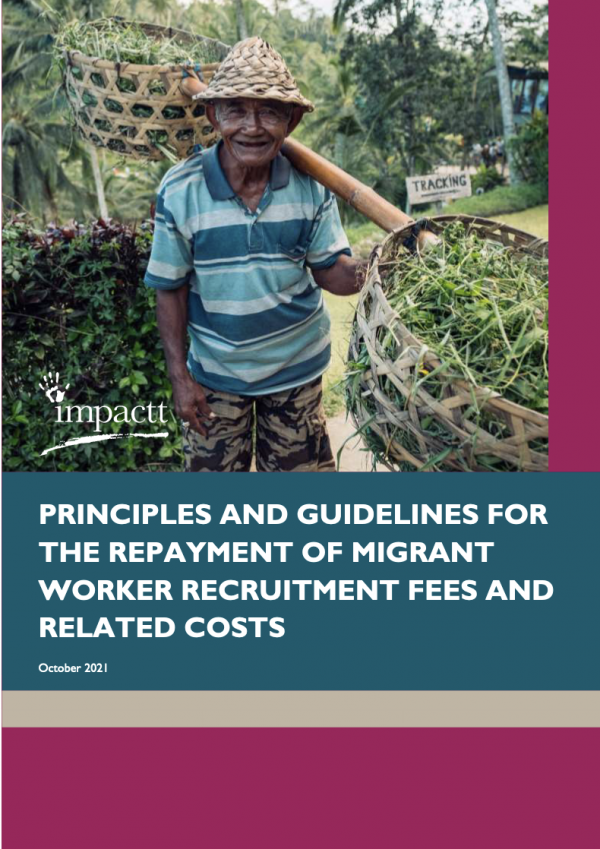
Principles and guidelines for the repayment of migrant worker recruitment fees and related costs
Impactt has developed the guidance based on its in-depth field experience implementing repayment programmes. Impactt has worked with partners to facilitate repayment of over US$111 million in recruitment costs to over 86,000 migrant workers employed by 210 companies around the globe, acting both for employers and for other supply chain actors. The guidelines have also benefited from consultation with over 150 expert stakeholders from international bodies, governmental organisations, international trade unions, multi-stakeholder initiatives, investors, CSOs, consultancies, lawyers, activists, campaigners, employers, former migrant workers and multi-national companies.
Type of document :
Country/Region :
Year of publication :
Theme : , ,
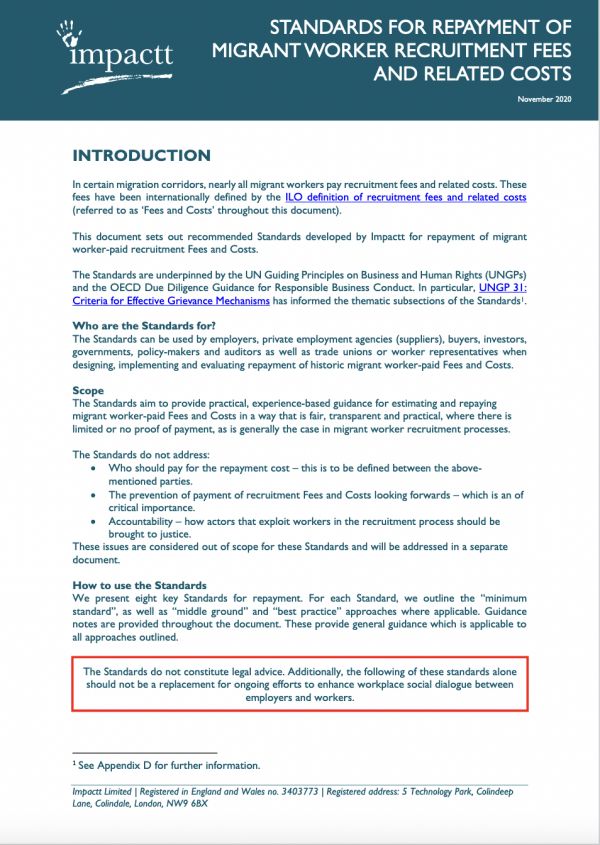
Standards for repayment of migrant worker recruitment fees and related costs
This document sets out recommended Standards developed by Impactt for repayment of migrant worker-paid recruitment Fees and Costs.
Type of document :
Country/Region :
Year of publication :
Theme : ,
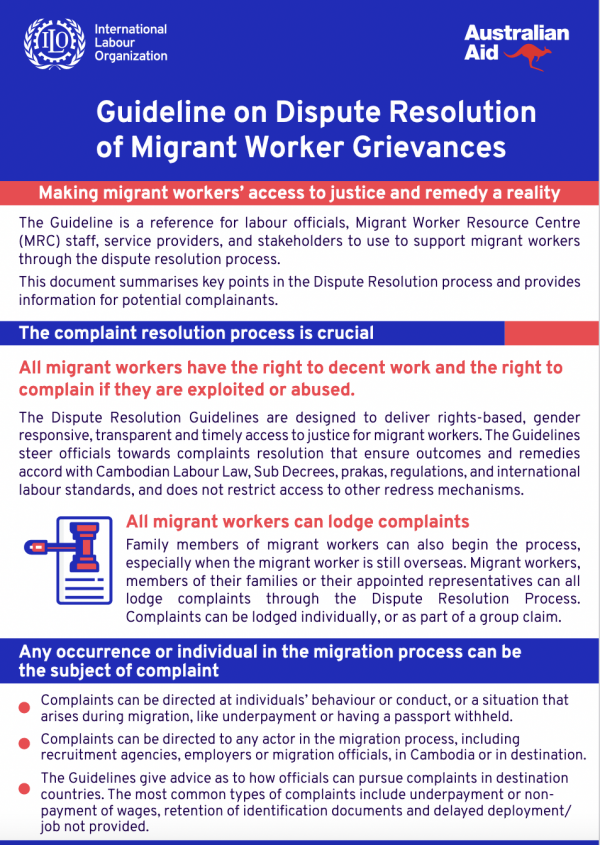
Guideline on Dispute Resolution of Migrant Worker Grievances
The Guideline is a reference for labour officials, Migrant Worker Resource Centre (MRC) staff, service providers, and stakeholders to use to support migrant workers through the dispute resolution process.
The Dispute Resolution Guidelines are designed to deliver rights-based, gender responsive, transparent and timely access to justice for migrant workers. The Guidelines steer officials towards complaints resolution that ensure outcomes and remedies accord with Cambodian Labour Law, Sub Decrees, prakas, regulations, and international labour standards, and does not restrict access to other redress mechanisms.
Family members of migrant workers can also begin the process, especially when the migrant worker is still overseas. Migrant workers, members of their families or their appointed representatives can all lodge complaints through the Dispute Resolution Process.
Complaints can be lodged individually, or as part of a group claim. This document summarises key points in the Dispute Resolution process and provides information for potential complainants.
Type of document :
Country/Region :
Year of publication :
Theme :
Country of origin complaints mechanisms for overseas migrants from Myanmar
This Briefing Paper is the first in a series of Briefing papers providing technical input on particular migration issues being produced by the ILO Yangon supported by Livelihoods and Food Security Trust Fund (LIFT). The briefing paper provides the international legal framework and guidelines governing complaints or grievance mechanisms for migrants. It analyses different mechanisms currently available to Myanmar migrants including the government complaints mechanism, embassies, Myanmar Overseas Employment Agencies Federation (MOEAF), Anti-Trafficking in Persons Division, ILO Forced Labour complaints mechanism and civil society organisations and labour organisations support services. It provides examples of good practices from other countries of origin.
Finally the paper proposes a set of policy recommendations to extend and improve complaints mechanisms for migrants. The Annex includes relevant treaties, examples of laws and structures from other countries, a tabulated breakdown of lessons learnt and samples of complaints forms. Other Briefing papers in this series to support the development of improved labour migration governance in Myanmar will include Recruitment, Social Protection and Policy Cohesion.
Type of document :
Country/Region :
Year of publication :
Theme :