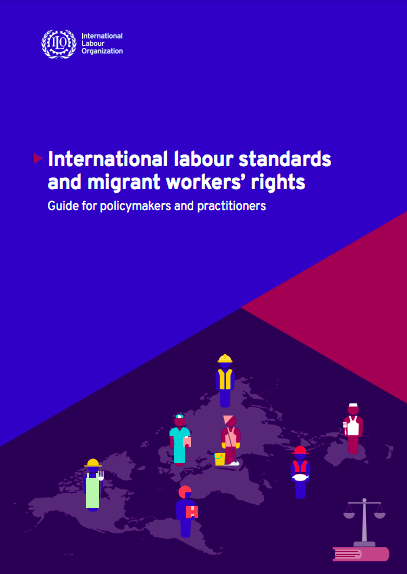
International labour standards and migrant workers’ rights: A Guide for policymakers and practitioners
This ILO guide brings together the international labour standards most relevant to the protection of migrant workers’ rights. It offers practical guidance on how these standards apply throughout the migration experience, supporting rights-based labour migration and decent work for all.
Migrant workers make essential contributions to labour markets, economic growth and social protection systems worldwide. When labour migration is well governed, it supports productivity, skills development and inclusive and sustainable development in countries of origin, transit and destination. International labour standards provide a robust framework to ensure these contributions are fully realised, grounded in dignity, equality and decent work for all.
This Guide presents an overview of the international labour standards most relevant to migrant workers from the perspective of their rights throughout the migration experience. It brings together, in a single resource, the key principles, rights and protections set out in relevant ILO standards and explains how they apply at different stages of labour migration. The Guide covers fundamental principles and rights at work, fair recruitment, equality of opportunity and treatment, working conditions, social protection, and access to justice.
Drawing on the guidance from ILO supervisory bodies and illustrative examples from diverse regional and national context, the Guide serves as a practical reference for policymakers, social partners and practitioners. It supports the design and implementation of rights-based labour migration policies that promote decent work, fair migration and inclusive labour markets.
Type of document :
Country/Region :
Year of publication :
Theme : ,
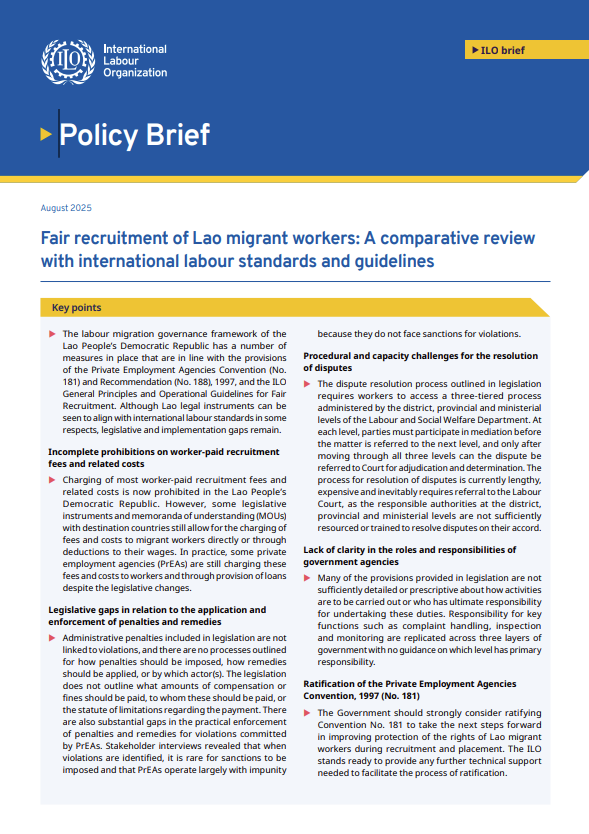
Policy brief: Fair recruitment of Lao migrant workers: A comparative review with international labour standards and guidelines
This policy brief offers a comparative analysis of the labour migration governance framework in relation to international standards and guidelines and provides recommendations to help ensure fair recruitment and decent work for Lao migrant workers.
The ILO Ship to Shore Rights South-East Asia programme has been working in close collaboration with the Ministry of Labour Social Welfare to strengthen policy and legislation related to the recruitment of Lao migrant workers since 2020. To support this effort, a comparative analysis of the labour migration governance framework was undertaken in relation to key international labour standards and guidelines, including the Private Employment Agencies Convention, 1997 (No. 181) and the ILO General Principles and Operational Guidelines for Fair Recruitment.
Although the Lao policy and legal framework was found to be in alignment with international labour standards and guidelines in many respects, the analysis identified significant legislative and implementation gaps. These include incomplete prohibitions on worker-paid recruitment fees and related costs, challenges in enforcing penalties and providing remedies for abuses, procedural and capacity challenges in dispute resolution, and lack of clarity and in the responsibilities of government agencies.
The policy brief recommends that the Lao Government consider ratifying the Private Employment Agencies Convention, 1997 (No. 181) to take the next steps forward in improving protection of the rights of Lao migrant workers during recruitment and placement. The ILO stands ready to provide any further technical support required by the Lao Government and social partners to facilitate the process of ratification for Convention No. 181 in the Lao People’s Democratic Republic.
Type of document :
Country/Region :
Year of publication :
Theme : , ,
Dr. Elaine Lebon-McGregor’s perspective from the ILO FRI Global Conference
Posted at June 13th 2025 12:00 AM | Updated as of June 13th 2025 12:00 AM
Region/Country :
|Themes : , ,
Winners of 2023 ILO Global Media Competition on Labour Migration announced
Posted at December 15th 2023 12:00 AM | Updated as of December 15th 2023 12:00 AM
Region/Country :
|Themes : , , , , , , , ,
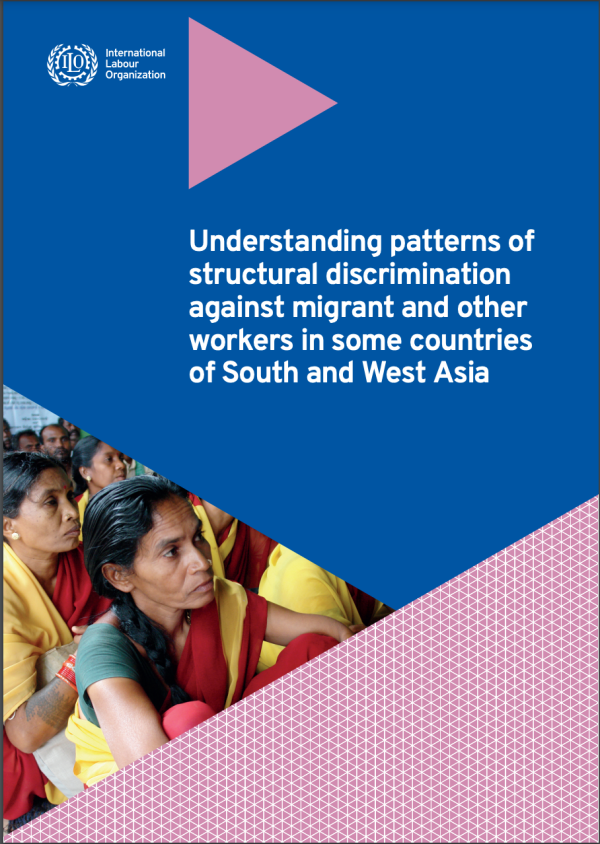
Understanding patterns of structural discrimination of migrant and other workers in some countries of South and West Asia
This background paper reviews the literature that sheds light on the structural patterns of discrimination against migrant workers in some countries of South and West Asia. It also articulates recommendations that would help officials in UN agencies, international organizations, constituents and other civil society individuals and groups, while referring to the existing evidence of structural discrimination to support the application of international labour standards.
While references to international non-discrimination standards do occasionally surface in public discourses, this paper reviews evidence that discrimination in the world of work is not only characterized by socially deviant cases of discriminatory abuse, as reported in the media, but is rather intrinsic to the way various market economies and political systems are structured. This is manifested by indicators of privilege for some and indicators of deprivation for those at the bottom of the social and political hierarchies, including the interaction between both.
Type of document :
Country/Region : , , , , , , ,
Year of publication :
Theme : , , , , ,
Organizing women migrant workers: Handout compendium
This handout compendium is meant to be used with the training manual "Organizing women migrant workers: Manual for trade unionists in ASEAN".
This handout compendium is a part of the training manual "Organizing women migrant workers: Manual for trade unionists in ASEAN". The handout compendium is meant to be used with the training manual. The training manual was produced jointly by the ILO Bureau for Workers’ Activities (ACTRAV) and the programme Safe and Fair: Realizing women migrant workers’ rights and opportunities in the ASEAN region. ACTRAV and Safe and Fair aim for this training manual and handout compendium to enable trade unions to address the specific needs of women migrant workers, bringing these two elements to
Type of document :
Country/Region :
Year of publication :
Theme : , , , ,
Organizing women migrant workers: Manual for trade unionists in ASEAN
This training manual was produced in collaboration between ILO Bureau for Workers’ Activities (ACTRAV) and Safe and Fair: Realizing women migrant workers’ rights and opportunities in the ASEAN region, a joint programme of the International Labour Organization and UN Women under the EU-UN Spotlight Initiative to eliminate violence against women and girls.
Trade unions regionally and globally often work on either migrants’ issues, or on gender equality and women’s empowerment. ACTRAV and Safe and Fair aim for this training manual to enable trade unions to address the specific needs of women migrant workers, bringing these two elements together.
This training manual was produced jointly by the ILO Bureau for Workers’ Activities (ACTRAV) and the programme Safe and Fair: Realizing women migrant workers’ rights and opportunities in the ASEAN region. Safe and Fair is jointly implemented by the ILO and UN Women, under the multi year European Union–United Nations Spotlight Initiative to end violence against women and girls.
Type of document :
Country/Region :
Year of publication :
Theme : , , , ,
Protecting the Rights of Migrant Workers in an Irregular Situation and Preventing Irregular Labour Migration: A Compendium
The Compendium presents the situations that can lead migrant workers into irregularity, the rights of migrant workers in irregular situations, and the relevant international standards and good practice. It highlights laws, policies and practices that can help prevent irregular labour migration, and facilitate respect and promotion of the human rights of all migrant workers, regardless of status”. The Compendium is not intended to be exhaustive but is instead a living document that will be regularly updated with new examples and experiences. It seeks to encourage the sharing of good practices by states, social partners, and other actors concerned and to contribute to the attainment of the objectives of the Global Compact for Safe, Orderly and Regular migration.
Some of the references will be further updated in early 2022.
Type of document :
Country/Region :
Year of publication :
Theme : , , , ,
ITUC Policy Brief: a new social contract for migrant workers
Decent Work deficits, xenophobia, racism and discrimination, conflicts, insufficient mitigation and adaptation to Climate Change mean many people have no choice but to accept substandard employment or undignified working conditions.
A New Social Contract is more urgent than ever to create more inclusive societies and economies, where migrants and their families can work and live with dignity. Workers call for a rights-based governance of migration that is designed, implemented and monitored through social dialogue and with international labour standards – such as freedom of association and collective bargaining rights – at the forefront.
Type of document :
Country/Region :
Year of publication :
Theme : , , , , , ,
Understanding patterns of structural discrimination against migrant and other workers in some countries of South and West Asia
This background paper reviews the literature that sheds light on the structural patterns of discrimination against migrant workers in some countries of South and West Asia. It also articulates recommendations that would help officials in UN agencies, international organizations, constituents and other civil society individuals and groups, while referring to the existing evidence of structural discrimination to support the application of international labour standards.
While references to international non-discrimination standards do occasionally surface in public discourses, this paper reviews evidence that discrimination in the world of work is not only characterized by socially deviant cases of discriminatory abuse, as reported in the media, but is rather intrinsic to the way various market economies and political systems are structured. This is manifested by indicators of privilege for some and indicators of deprivation for those at the bottom of the social and political hierarchies, including the interaction between both.
Type of document :
Country/Region : , , , , , , ,
Year of publication :
Theme : , , , , ,