Achieving fair and ethical recruitment: Improving regulation and enforcement in the ASEAN region
This report focuses on the efforts of ASEAN Member States to foster fair and ethical recruitment. It maps the laws and regulations, and moreover, the enforcement mechanisms States have employed, and reviews evidence of the results achieved.
Job information can be a rare commodity in the labour market – employers know what skills they need but not where to find them; while the workers know their skills but not who is in need of them. Intermediaries such as recruiters play a useful role in resolving this asymmetry of information. In the real world, however, the operation of the recruitment market is highly imperfect. Common recruitment-related abuses faced by migrant workers in elementary occupations include: paying exorbitant recruitment fees to recruiters, deception concerning the terms and conditions of employment contracts, processing fake documents, confiscation of passports or ID documents, and physical as well as emotional violence and threats. The ILO’s General Principles and Operational Guidelines for Fair Recruitment, call on Member States to adopt appropriate legislation and policies to protect the rights of migrant workers.
In the Association of Southeast Asian Nations (ASEAN) region, where labour migration has become prominent, fair and ethical recruitment can prevent migrant workers from experiencing abusive conditions, including trafficking and forced labour. This report focuses on the efforts of the ASEAN Member States to foster fair and ethical recruitment. It maps the laws and regulations of these Member States and the enforcement mechanisms they have employed, and reviews evidence of the results they may have achieved.
Type of document :
Country/Region :
Year of publication :
Theme : ,
Virtual Roundtable Discussion: Protecting the Rights of Migrant Workers in Irregular Situations
|21st November 2022 Time : 3:00pm - 5:00pm
|Region/Country :
Theme : , , ,
Peer to peer knowledge sharing webinar on fair recruitment and labour inspection
|24th May 2022 Time : 4:00pm - 5:30pm
|Region/Country :
Theme : , ,
Technical tripartite webinar for the ratification campaign of ILO Conventions on Employment Service, and Private Employment Agencies
|12th May 2022 Time : 10:00am - 12:00pm
|Region/Country :
Theme : , , ,
ILO Fair Recruitment Initiative and Alliance 8.7: Accelerating progress towards meeting SDG target 8.7. through fair recruitment promotion.
|12th May 2022 Time : 3:00pm - 4:30pm
|Region/Country :
Theme : , ,
The ILO launches the second phase of the Fair Recruitment Initiative
Posted at April 8th 2021 12:00 AM | Updated as of April 8th 2021 12:00 AM
Region/Country :
|Themes : , , , ,
Peer-to-peer knowledge sharing webinar on fair recruitment and labour inspection
Posted at July 12th 2021 12:00 AM | Updated as of July 12th 2021 12:00 AM
Region/Country :
|Themes : ,
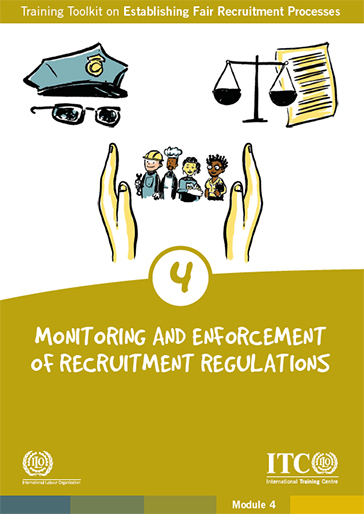
ITC-ILO training: Monitoring and enforcement of recruitment regulations - Establishing Fair Recruitment Processes
By the end of this module, participants will be able to:
- Understand governments’ responsibilities in regards to the monitoring and enforcement of recruitment regulations
- Have an introductory knowledge of the use of monitoring as an enforcement mechanism and its contribution to ensuring the fair recruitment of workers
- Recognize the key challenges associated with complaints mechanisms and access to justice for workers, including migrant workers
- Explore the most commonly used legislative mechanisms for prosecuting recruitment abuses
- Appreciate the particular role of trade unions and non-governmental organizations in promoting and monitoring fair recruitment
- Become familiar with pilot initiatives of workers’ organizations to protect and empower workers during the recruitment and placement process
- Become acquainted with self-regulation mechanisms adopted by private recruitment agencies
Type of document :
Country/Region :
Year of publication :
Theme : ,
Regulating labour recruitment to prevent human trafficking and to foster fair migration: Models, challenges and opportunities
This working paper presents the role of international labour standards in regulating recruitment and provides a preliminary overview of national laws, policies, regulations and enforcement mechanism which aim to prevent fraudulent recruitment practices and protect workers from unscrupulous labour recruiters. It aims to establish a framework and an initial baseline for the implementation of the second strategic pillar of the ILO’s Fair Recruitment Initiative – strengthening laws, policies and enforcement mechanisms to protect workers from abusive and fraudulent recruitment practices.
Overall, the paper addresses three main research questions:
- What are the main international labour standards with regards to labour recruitment and how have the ILO supervisory bodies assessed national regulation and its implementation?
- What are the different models and approaches to regulate labour recruitment? What are the most recent trends in terms of statutory regulation?
- How are private employment agencies monitored and how are statutory regulations enforced? What are the main challenges with regards to enforcement?
The paper also provides recommendations based on emerging national and regional experiences and identifies research gaps which should be tackled in the coming years.
Type of document :
Country/Region :
Year of publication :
Theme : , ,
Conducting Labour Inspections on Construction - A guide for labour inspectors
The objective of this guide is to assist labour inspectors fulfil their inspectorial function by providing information, in a user friendly format on, a suggested methodology for conducting inspections of construction activities; from planning to reporting on the inspection, as well as providing technical information which labour inspectors can supply to employers and workers, so as to ensure “Decent Work”.
The construction sector plays an essential role in the socio-economic development of many countries, not least through the number of workers engaged in construction activities. However the employment relationship, the legal link between employers and workers, in construction activities is often unclear and this regularly results with workers not having access to certain rights and benefits, combined with this, workers are often exposed to many hazards. These factors mean that working conditions on many construction sites cannot be considered as “Decent work”, workers do not have a fair, just, safe and healthy working environment.
Inspections conducted by labour inspectors have an important role in ensuring compliance with legislation and thus decent working conditions for workers in all sectors, including construction. The guide details many of the working conditions that labour inspectors will address, namely, the employment relationship, representation rights, salaries and wages, working hours and holidays, employment of young person’s and foreign nationals as well as the hazards that workers can be exposed to. Internationally recognised safety measures are documented that, if followed, will reduce the likelihood of workers suffering from accidents and diseases.
Type of document :
Country/Region :
Year of publication :
Theme : ,