Establishing Ethical Recruitment Practices in the Hospitality Industry
This document provides practical guidance for the hospitality industry on how to ethically recruit international migrant workers within business enterprise operations and supply chains. It has been developed by IOM in partnership with the Sustainable Hospitality Alliance.
This guidance aligns with ethical recruitment principles from IOM’s IRIS Ethical Recruitment initiative and the IRIS Standard, which is a global, multi-stakeholder standard that defines and establishes an operational benchmark for ethical recruitment. It is also closely aligned with the Sustainable Hospitality Alliance’s Principles on Forced Labour: (a) every worker should have freedom of movement; (b) no worker should pay for a job; and (c) no worker should be indebted or forced to work.
This guidance is global in nature and designed primarily for hotels. It is applicable to both multinational enterprises and small- and medium-sized enterprises. It can also serve as a resource for other tourism-related industries, as the principles of ethical recruitment are universal.
Guidance Notes and Tools
Guidance Note A: Establishing Ethical Recruitment Practices in the Hospitality Industry
Guidance Note B: Building the knowledge and capacity of hotels to implement ethical recruitment
Guidance Note C: Working with civil society and including migrant worker voice
Tool 1: Working with labour recruiters and employment agencies
Tool 2: Interviewing migrant workers about their recruitment and employment experiences
Tool 3: Incorporating ethical recruitment into procurement practices
Tool 4: Access to remedy and business grievance mechanisms
Tool 5: Frequently asked questions about migrant workers and recruitment
Type of document :
Country/Region :
Year of publication :
Theme : , , , ,
IRIS Handbook for Governments on Ethical Recruitment and Migrant Worker Protection: Chapter 4 – Advancing inter-State cooperation
This resource is the fourth chapter of the IRIS Handbook for Governments on Ethical Recruitment and Migrant Worker Protection. With direct relevance to inter-State labour migration governance mechanisms and processes, it provides governments with practical guidance on how to integrate, mainstream and prioritize ethical recruitment in these cooperative activities.
The chapter covers a broad range of relevant topics including: the value and benefits of inter-State cooperation in international labour recruitment governance; the landscape of relevant labour migration mechanisms and processes (including labour migration agreements and inter-State consultation mechanisms); and specific guidance and examples of how to advance and prioritize ethical recruitment in these endeavours. Guidance is intended for government officials in their capacities as negotiators, regulators, inspectors, labour attachés and consular officials at different levels of administration (national, subnational) and across relevant portfolios (labour and employment, migration, foreign affairs, etc.).
The IRIS Handbook is IOM’s flagship global guidance tool for governments on ethical recruitment and migrant worker protection. It builds directly on the Montreal Recommendations on Recruitment: A Road Map towards Better Regulation with more detailed measures for consideration, and profiles relevant concrete actions that governments around the world have taken.
Type of document :
Country/Region :
Year of publication :
Theme : , , ,
IRIS Handbook for Governments on Ethical Recruitment and Migrant Worker Protection: Chapter 3 – Strengthening the effectiveness of inspectorates
This resource is the third chapter of the IRIS Handbook for Governments on Ethical Recruitment and Migrant Worker Protection. It provides governments with practical guidance on how to strengthen the effectiveness of inspectorates to ensure that migrant workers are empowered and protected during the inspection process.
The chapter covers a broad range of relevant topics including setting up an effective inspectorate in law and practice (legal framework, monitoring and enforcement strategy, resources, process and decision-making, collaborative approaches) and migrant-sensitive inspection approaches and methods (facilitative conditions for migrant workers, inspection modalities, interview techniques). Guidance is intended for government officials in their capacities as inspectors at various levels of administration (national, subnational) and across relevant portfolios (labour, migration, consumer protection, etc.). It can be applied in countries of origin, transit and destination.
The IRIS Handbook is IOM’s flagship global guidance tool for governments on ethical recruitment and migrant worker protection. It builds directly on the Montreal Recommendations on Recruitment: A Road Map towards Better Regulation with more detailed measures for consideration, and profiles relevant concrete actions that governments around the world have taken.
Type of document :
Country/Region :
Year of publication :
Theme : , , ,
IRIS Handbook for Governments on Ethical Recruitment and Migrant Worker Protection: Chapter 2 – Implementing and improving licensing frameworks
This resource is the second chapter of the IRIS Handbook for Governments on Ethical Recruitment and Migrant Worker Protection. It provides governments with practical guidance on how to implement and improve the administration of private international labour recruiter frameworks, with an emphasis on ensuring recruiters are competent in and accountable to ethical recruitment principles.
The chapter covers a broad range of relevant topics including: knowledge of ethical recruitment standards (information and educational options); licence application and assessment (screening process, eligibility and requirements); licence features and conditions; and accountability measures (oversight and transparency). Guidance is intended for government officials in their capacities as regulators and inspectorates of private labour recruiters at various levels of administration (national, subnational) and across relevant portfolios (labour, immigration, consumer protection, etc.). It can be applied in countries of origin, transit and destination.
The IRIS Handbook is IOM’s flagship global guidance tool for governments on ethical recruitment and migrant worker protection. It builds directly on the Montreal Recommendations on Recruitment: A Road Map towards Better Regulation with more detailed measures for consideration, and profiles relevant concrete actions that governments around the world have taken.
Type of document :
Country/Region :
Year of publication :
Theme : , , , , ,
IRIS Handbook for Governments on Ethical Recruitment and Migrant Worker Protection: Chapter 1 - Adopting a rights-based regulatory approach to international labour recruitment
This resource is the first chapter of the IRIS Handbook for Governments on Ethical Recruitment and Migrant Worker Protection. It provides governments with practical guidance on how to adopt and strengthen a rights-based framework to regulate private international labour recruiters and uphold migrant worker protection. The chapter covers a comprehensive range of themes including: regulatory measures (key definitions and terms, legal status of labour recruiters, ethical rules of conduct); enforcement and oversight (mandating authorities and sanctions); and access to justice (complaint mechanisms and complementary measures). Guidance is intended for government officials in their capacities as policymakers and regulators at various levels of administration (national, subnational) and across relevant portfolios (immigration, labour, foreign affairs, etc.). It can be applied in countries of origin, transit and destination.
The IRIS Handbook is IOM’s flagship global guidance tool for governments on ethical recruitment and migrant worker protection. It builds directly on the Montreal Recommendations on Recruitment: A Road Map towards Better Regulation with more detailed measures for consideration, and profiles relevant concrete actions that governments around the world have taken.
Type of document :
Country/Region :
Year of publication :
Theme : , , , ,
Migrant Worker Guidelines for Employers
This publication is to provide practical guidance for business enterprises on how to recruit and employ international migrant workers ethically and responsibly. The guidance offers concrete steps employers across various sectors can take to run their businesses in a manner that respects human and labour rights of migrant workers. The guidance is primarily for human resources and personnel engaged with migrant workers and can be integrated in existing company policies, procedures and practices.
The guidance builds on the United Nations Guiding Principles on Business and Human Rights (UNGP) and relevant international human rights and labour standards and frameworks on international migration. It has been developed as part of the IOM’s Corporate Responsibility in Eliminating Slavery and Trafficking (CREST) initiative, through an extensive multi-stakeholder consultation process.
The guidance is accompanied by a set of supporting tools including checklists, guidance notes and other useful documents, to help employers develop and implement the system, principles and practices to manage the labour migration process.
Supporting tools
- Summary - Common challenges and Risks Experienced by Migrant Workers at All Stages of Labour Migration
- Checklist - Labour Recruiter Service Agreements
- Guidance Note - Recruitment Fees and Related Costs
- Checklist - Employment Contracts
- Checklist - Migrant Workers' Accommodations
Type of document :
Country/Region :
Year of publication :
Theme : , , , , ,
Lessons Learned Part 1: Outreach to migrant women in areas of origin
This document describes the lessons learned by the Work in Freedom programme on outreach to migrant women in areas where they migrate from. This compilation was preceded by an earlier edition of Lessons Learned in October 2017, followed by another one in February 2019. The findings are important to inform Governments, donors and civil society groups on their policies regarding the protection of migrant women, safe migration, pre-departure training and orientation and more.
Type of document :
Country/Region : , , , , , ,
Year of publication :
Theme : , ,
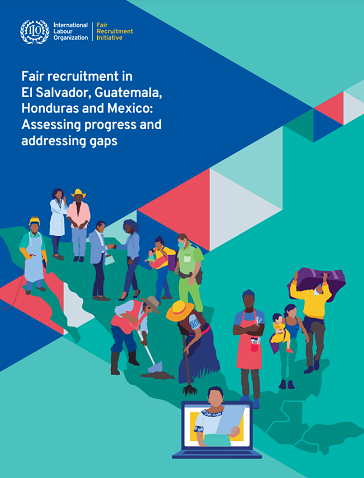
Fair recruitment in El Salvador, Guatemala, Honduras and Mexico: Assessing progress and addressing gaps
Analysis of progress and gaps in the regulatory framework, policies and enforcement on fair recruitment in the region and in each country, with recommendations to address regional and national challenges.
The document also compiles cases, good practices and recent efforts in various sectors and regions at local and international level by governments, employers' organisations and workers' organisations.
Type of document :
Country/Region : , , , ,
Year of publication :
Theme : , ,
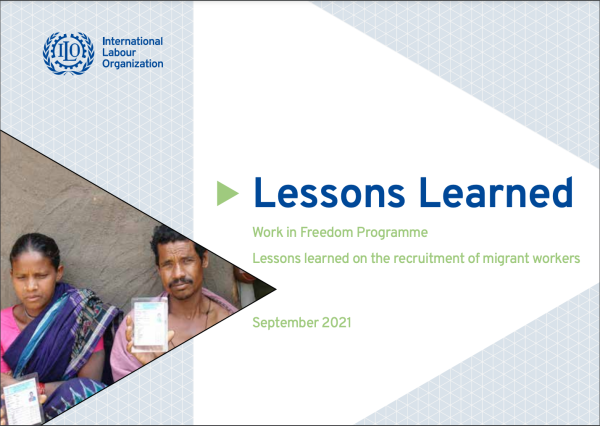
Lessons Learned Part 2: Recruitment
This document describes the lessons learned by the Work in Freedom programme on recruitment of migrant workers. This compilation was preceded by an earlier edition of Lessons Learned in October 2017, followed by another one in February 2019. This new edition focuses particularly on recruitment of migrant workers. It lists and describes the nature of both conventional and non-conventional interventions and reviews some of the assumptions behind the rationale for these interventions.
Type of document :
Country/Region : , , , , , ,
Year of publication :
Theme : , ,
In the Shadow of the State: Recruitment and Migration of South Indian Women as Domestic Workers to the Middle East
This background paper describes and analyses the drivers, pathways and experiences of migrant women from South India as domestic workers in Gulf countries. It is based on primary and secondary research.
Type of document :
Country/Region : , , , ,
Year of publication :
Theme : , , , , ,