

West Africa moves towards a common approach on bilateral labour migration agreements and fair recruitment of migrant workers
Posted at July 9th 2026 12:00 AM | Updated as of July 9th 2026 12:00 AM
Region/Country : Nigeria, Africa
|Thèmes : Fair recruitment, Labour migration governance
ECOWAS Member States, OTUWA and FOPAO met in Abuja to embed fair recruitment into bilateral labour migration agreements, and agreed that the absence of standardised common standards for the region weakens the whole region.
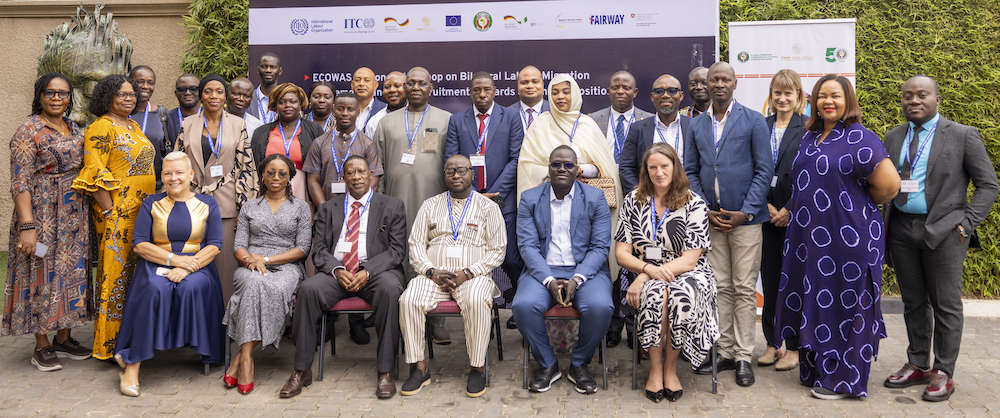
ABUJA, Nigeria — Twelve ECOWAS Member States have agreed to work towards common regional standards for the bilateral labour migration agreements (BLMAs) they negotiate with destination countries in Europe and the Arab States, during a five-day regional workshop convened by the ECOWAS Commission with the International Labour Organization (ILO) and the International Training Centre of the ILO (ITC-ILO).
Held in Abuja from 6 to 10 July, the Regional Workshop on Fair Recruitment and Bilateral Labour Migration Agreements brought together labour migration experts from Benin, Cabo Verde, Côte d’Ivoire, The Gambia, Ghana, Guinea, Guinea-Bissau, Liberia, Nigeria, Senegal, Sierra Leone and Togo. They were joined by the Federation of West African Employers’ Organisations (FOPAO), the Organization of Trade Unions of West Africa (OTUWA), the International Organization for Migration (IOM), the International Centre for Migration Policy Development (ICMPD) and GIZ.
The workshop was chaired by Mr DEEN Ibrahim Joaque of Sierra Leone’s Ministry of Employment, Labour and Social Security, with Côte d’Ivoire, Cabo Verde and The Gambia serving as rapporteurs.
A region at the centre of global mobility
The numbers framed the discussion. The ILO estimates that there are 167.7 million international migrant workers worldwide, almost 39 per cent of them women. More than 80 per cent of labour migration on the African continent takes place within Africa itself, and West Africa hosts the largest concentration of migrant workers on the continent — 4.3 million, according to 2024 ILO figures — facilitated by the ECOWAS Protocol on Free Movement of Persons.
Opening the workshop on behalf of the ECOWAS Commission’s Director of Humanitarian and Social Affairs, Dr Alves D’ALMADA Fernando Jorge reaffirmed the Commission’s commitment to advancing labour migration governance in West Africa, recalling the 1979 Free Movement Protocol and linking the discussion to the ECOWAS Regional Labour Migration Strategy 2025–2030. He emphasised that agreements must be clear, detailed and enforceable from the start, because too often the risks begin at recruitment — which is why practical provisions and strong coordination matter.
Speaking for the ILO, Mr Guité DIOP, FMM Project Manager, delivered remarks on behalf of Dr Vanessa Phala, ILO Director for Nigeria, Ghana, Liberia and Sierra Leone and Liaison Office for ECOWAS. He noted that labour migration, when properly governed, contributes significantly to the socio-economic development of origin, transit and destination countries — but that the process carries complex challenges in governance, worker protection and international cooperation.
As more BLMAs are negotiated or revised with European countries and the Arab States, the ILO stressed, those agreements represent a real opportunity to expand regular pathways — provided they contain strong fair recruitment provisions.
The bargaining power problem
Across five days, one theme recurred more than any other: unequal bargaining power.
The conclusion was consistent. West African countries should avoid negotiating in isolation and instead build a common position, shared minimum standards and stronger technical preparation — in effect, regional solidarity as a negotiating instrument. For ECOWAS countries, there is real value in building common positions: they can strengthen protection for nationals abroad and support more coherent labour migration governance across the region. FOPAO argued that common positions are necessary precisely to prevent downward pressure and competition between countries of origin.
From signature to practice
Participants were equally clear that signing an agreement is the easier half of the task.
It was agreed that the central challenge is often not signature itself but implementation, and it was recommended that every agreement be accompanied by a clear implementation roadmap. The absence of labour attachés in many destination countries was identified as a major enforcement gap, prompting a proposal that Member States explore shared or collaborative arrangements so that limited individual presence abroad does not prevent monitoring and follow-up.
Recurring gaps were named directly: fraudulent recruitment and unlicensed agencies, contract substitution, unclear allocation of recruitment costs, missing provisions on social security portability, family reunification, skills recognition and gender responsiveness, and weak labour market information systems.
Outcomes and next steps
The workshop produced minimum standards for BLMAs and a regional Fair Recruitment Roadmap, laying the foundations for an ECOWAS Fair Recruitment Workplan and for common regional positions in future negotiations.
Closing the meeting, OTUWA underlined the protection of vulnerable migrant workers and the value of a unified ECOWAS voice, while FOPAO stressed that fair recruitment also serves enterprises by curbing fraudulent practices and addressing skills gaps. The ECOWAS Commission called for movement towards common standards, better enforcement of existing agreements, stronger oversight of recruitment processes, and continued social dialogue to build regional consensus.
The ILO reaffirmed its commitment to accompanying ECOWAS and its Member States under the ECOWAS–ILO Memorandum of Understanding (MoU).
The workshop was delivered through the combined support of the EU-funded FMM West Africa II programme, the Fair Recruitment Forward global project and the ACTION project, both funded by GIZ, and the FAIRWAY II programme supported by the Swiss Agency for Development and Cooperation (SDC).
At the end of the day, the goal is simple: fair and effective labour migration governance rooted in international labour standards and aligned with AU and ECOWAS guidance.